
|
News North Korea fires 23 missiles in busiest launch day ever; 1 lands off ROK coastAir raid alert issued for Ulleung Island as short-range missile splashes down south of inter-Korean maritime border
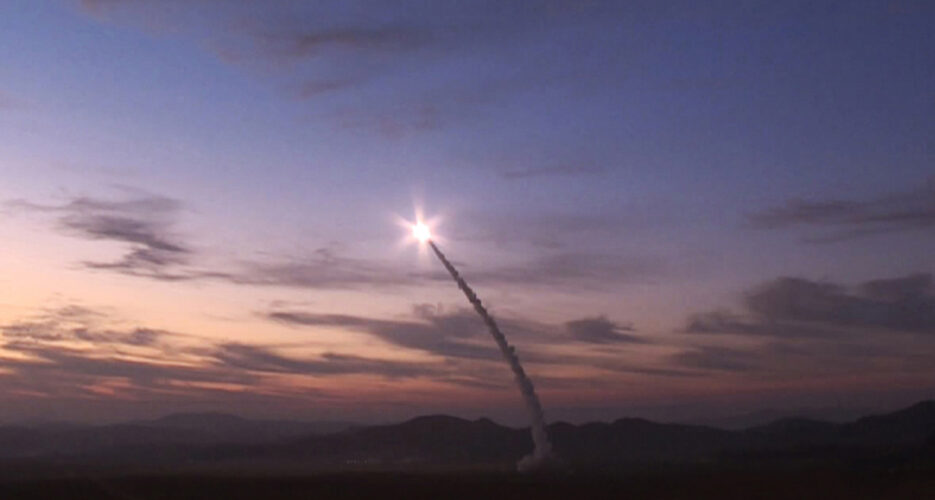 North Korea fired at least 23 missiles into the waters off the east and west coast throughout the day Wednesday, including one that was directed toward South Korea’s Ulleung Island before splashing down off the east coast near South Korean territorial waters, according to the ROK military. It was Pyongyang’s busiest day of missile launches on record, and comes as Washington and Seoul conduct joint Vigilant Storm air force drills in South Korea. Seoul called Pyongyang’s missile launch into waters near the ROK east coast “unprecedented” and retaliated by firing missiles into waters a similar distance off the DPRK coast later in the day. ISLAND ALERTED At around 8:51 a.m. Wednesday, the ROK military “detected three short-range ballistic missiles that North Korea fired from Kangwon Province’s Wonsan region, and one of these fell in international waters of the East Sea, south of the Northern Limit Line (NLL),” according to the JCS. The joint chiefs added the missile fired toward Ulleung Island splashed down 16 miles (26 km) south of the NLL, just 35 miles (57 km) east of the coastal city of Sokcho and 104 miles (167 km) northwest of the island. This means it likely landed in South Korea’s exclusive economic zone (EEZ). “The North Korean missile launch today is the first time a DPRK missile fell near our territorial waters south of the NLL since the division [of the Korean Peninsula after World War II],” Army Lieutenant General Kang Shin-chul, JCS’s chief director of operations, said in a rare video announcement of the South Korean military’s position. “This is highly unprecedented and can never be tolerated,” Kang said, adding “our military declares we will respond firmly to this.” Hours later, ROK air force jets fired missiles into the high seas off North Korea’s coast in retaliation. The ROK issued an air raid alert for residents on the island shortly after detecting the missile, and kept the alert in place until 2 p.m. KST. Social media posts on Wednesday morning showed photos and videos of a red-banner emergency alert on South Korean television broadcasts that read, “Evacuate to the nearest underground shelter and listen to broadcasts.” The warning stated that the air raid alarm had been issued at 8:55 a.m.  TIMELINE: AT LEAST 23 MISSILES, 100 ARTILLERY SHELLS The 23 or more missiles North Korea fired on Wednesday morning included both short-range ballistic missiles (SRBMs) and surface-to-air missiles, according to the JCS. At 6:51 a.m. KST, the South Korean military detected four SRBMs that North Korea fired into the Yellow Sea off its west coast, likely launched from Jongju City and Phihyon County, North Phyongan Province. Two hours later at 8:51 a.m., North Korea fired three more SRBMs into the East Sea from the coastal city of Wonsan, Kangwon Province. One of these three missiles crossed the NLL into international waters, the first time that a DPRK ballistic missile has ever splashed down near ROK territorial waters, according to South Korea’s JCS. Two minutes after that missile was detected, an air raid alert was issued at 8:53 a.m. via a system under the Ministry of Interior and Safety Then, around 20 minutes later, at 9:12 a.m. KST, North Korea fired around 10 more missiles that the South Korean military saw as likely SRBMs and surface-to-air missiles, the JCS said. Some of these were fired from Rakwon, Jongphyong and Sinpho in South Hamgyong Province and splashed down into the East Sea. Others were launched from Onchon and Hwajin of South Phyongan Province and Kwail of South Hwanghae Province into the Yellow Sea. Then at around 1:27 p.m. KST, North Korea additionally fired around 100 shots of artillery into the inter-Korean maritime buffer zone established in 2018, but the shells landed north of the maritime border (NLL). The shells were likely fired from Kosong, Kangwon Province and represent a breach of the inter-Korean military agreement, the JCS said. At 4:34 p.m. KST, the Japanese defense ministry said North Korea launched yet another potential ballistic missile, the 18th reported missile of the day. The South Korean military then announced around 6:30 p.m. KST that it detected an “additional six surface-to-air missiles, etc. fired into the East and West Seas,” adding to the 17 they confirmed earlier in the day. The one missile Japan reported after 4 p.m. KST may be included in the six ROK counted most recently, bringing the total to at least 23 missiles fired Wednesday. The JCS is expected to release further details on the latest launch locations later. SOUTH KOREA STRIKES BACK In the afternoon, the JCS announced that South Korean jets fired missiles into waters off North Korea’s east coast at around 11:10 a.m. KST, after North Korea launched a total of at least 17 missiles in the morning. The ROK F-15K and KF-16 jets fired three “precision air-to-surface missiles” into “international waters north of the NLL,” according to the ROK military. The JCS later explained that the missiles were SPICE-2000 and SLAM-ER models. The JCS did not reveal the location from which the warplanes fired the missiles but explained that the projectiles splashed down at a distance north of the NLL that “corresponds” with where the DPRK missiles landed south of the border. “ROK military’s precision firing today has shown our willingness to firmly respond to any North Korean provocations, such as short-range ballistic missiles, and that we have the capability and readiness to precision-strike our enemy,” JCS said. “North Korea is continuing provocations despite our military’s repeated warnings,” the JCS added. “All responsibility lies with North Korea for any situation that happens afterward.” In an image taken just before 11:00 a.m. KST the same day, an unusual number of unidentified objects appeared in Planet Labs imagery outside a row of jet parking covers at the Wonsan airport, a military airbase, indicating the DPRK may have conducted jet drills of their own on Wednesday. The objects weren’t there the day before (left image) or other recent days, but the area in front of the parking covers looked similarly busy in an image taken on Oct. 8, a day North Korea said they conducted air force drills.   Images: Planet Labs PBH, edited by NK News © Korea Risk Group. All rights reserved. |


 SHARE
SHARE COPY LINK
 X
X MASTODON


Recent Stories