



North Korea renovates key missile launcher factory ahead of big military parade
Renovations at March 16 Factory accelerated in summer 2020, spurred by Kim Jong Un’s visit a year earlier
 SHARE
SHARE COPY LINK
 X
X MASTODON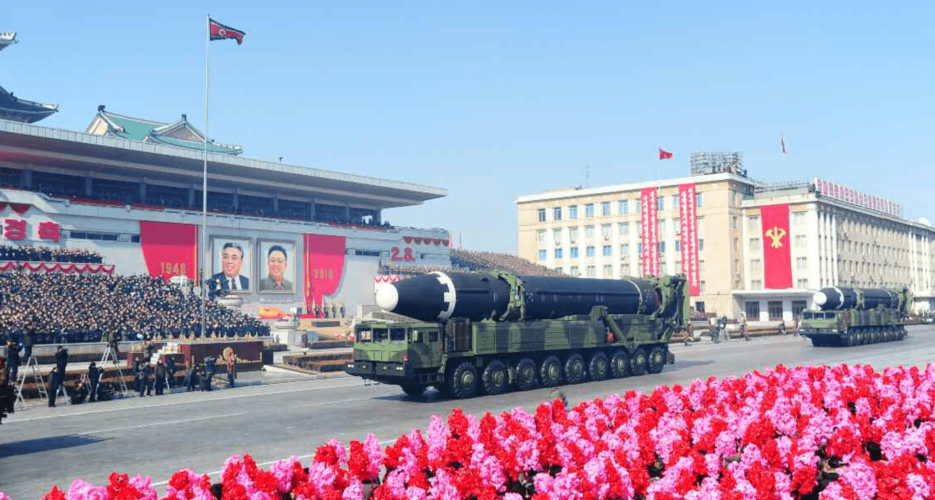
North Korea recently upgraded a key long-range missile launch vehicle factory, according to satellite imagery.
The renovations and new construction come ahead of a major military parade in October, where some analysts expect Pyongyang to show off a large number of new military vehicles produced at the March 16 Factory (3월16일공장).
The most recent upgrades at the factory took place between May 2020 and July 2020. This construction work follows a Dec. 2019 report that North Korea was constructing a new building on site that experts believe is for testing vehicles known as transporter erector launchers (TELs).
The factory is believed to be the nexus of North Korean TEL manufacturing. During a past visit there, Kim Jong Un said that the DPRK can produce TELs in unlimited quantities.
At the time, Kim was inspecting the country’s largest intercontinental ballistic missile (ICBM) — the Hwasong-15 — and its nine-axle TEL at the factory ahead of a late Nov. 2017 test launch.
The factory is located in the city of Phyongsong, just north of Pyongyang, and has also been called the Phyongnam General Machine Plant (평남기계종합공장) in state media.

THE LATEST UPGRADES
The latest upgrades made to the March 16 Factory are likely the result of Kim Jong Un’s instructions during a visit in June 2019, when he ordered for workers to carry out “phase two” of renovations and fix “problems” stemming from the first phase.
Kim gave instructions for the first phase during an inspection just weeks before visiting again for the Hwasong-15 launch in Nov. 2017. (He may have also provided guidance on the project during a secret visit — which you can read about at NK News here.)
As part of the latest batch of construction, a new vehicle drive-through facility and a few smaller buildings were completed in June 2020 (marked A in the image below), while a medium-sized warehouse was completely dismantled and rebuilt (D). This construction began in fall 2019, according to Planet Labs and Google Earth satellite imagery.
The newest project, which started in May 2020, appears to be the complete rebuilding of the on-site “revolutionary” museum (C) used to showcase past visits to the factory by the three Kim leaders.

All of the factory’s roads were also repaved since June, while roofing on other buildings was replaced (B, E) and some other small structures were removed before July, as well (B, F). Progress may have also been made on livestock and fish breeding facilities (possibly located at G) which Kim said should be improved during his June 2019 visit.
David Schmerler, a senior research associate with the James Martin Center for Nonproliferation Studies, told NK Pro that satellite imagery showing the new construction does not definitively suggest that North Korea made any new breakthroughs in TEL production since last December.
For example, Schmerler said that the turn radius of the looping outdoor driveways of a new drive-through building “looks too small to facilitate a TEL the size of the one used for the Hwasong-15.”
Schmerler and fellow researcher Jeffrey Lewis previously found that a new building to test TEL functionality was already built at the March 16 Factory during the latter half of 2019.
The new upgrades could be related to other types of civilian and military vehicles manufactured or assembled on site, according to Joseph Dempsey, a research associate for defense and military analysis at the International Institute for Strategic Studies (IISS).
Dempsey also told NK Pro that he believes the newest construction does not reveal “anything that screams TEL production.”
A TEL-TALE SIGN?
As sanctions and denuclearization negotiations with the U.S. restarted in 2018, North Korean media largely went silent on its plans for ICBM and TEL manufacturing.
But just months prior, in late 2017, Kim was openly talking about the March 16 Factory’s role in TEL production.
After checking out the Hwasong-15 on its nine-axle TEL at the factory on the night of Nov. 28, 2017, Kim reportedly said that the facilities could produce “as many [of the vehicles] as the country wants now that the munitions industry has made a breakthrough in putting the production of all parts of the vehicle on a domestic and Juche basis 100 percent.”

Sure, North Korean state media stopped promoting ICBM-related developments, likely to avoid offending the U.S. during negotiations in 2018. But if the factory followed through with Kim’s instructions for mass production, then there is a good chance the latest renovation work contributed to the production process.
Then what’s the next step of this saga, if not another ICBM test?
The answer may come at a military parade slated for Oct. 10 this year, where analysts believe more than a dozen TELs carrying Hwasong-15 missiles could roll through the streets of Pyongyang.
This theory is bolstered by the construction of new, permanent storage garages large enough to house these TELs at the Mirim parade training grounds.
This past summer, North Korea also made renovations to the support legs of a bridge in downtown Pyongyang, where the parade will take place. The bridge is located between the training area and Kim Il Sung Square, and the renovations to it are possibly meant to support a larger number of Hwasong-15 TELs than the four that crossed it during the Feb. 2018 parade.
Meanwhile, Kim Jong Un and other officials declared earlier this year that negotiations with the U.S. are essentially dead. It’s unlikely that North Korea will accommodate the U.S. by keeping its threatening ICBMs out of the upcoming parade, as they did in Sept. 2018.
Edited by Kelly Kasulis