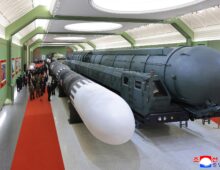
  Analysis Over dozen suspected missile shelters appear in Pyongyang before military paradeSatellite image suggests event will take place Wednesday night and could feature most ICBMs ever 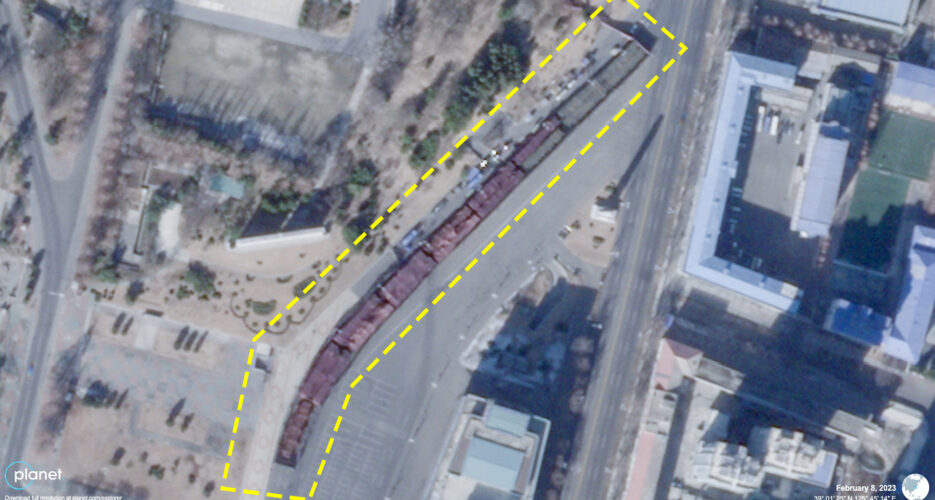 Over a dozen large shelters that could house North Korea’s largest nuclear missiles appeared on Wednesday afternoon outside a central Pyongyang square, where a military parade looked set to take place in the coming hours, according to NK Pro analysis of satellite imagery. An informed source in the capital told NK Pro that authorities began closing off streets around Kim Il Sung Square around the same time Wednesday, while satellite imagery showed other signs of an imminent parade and no strong evidence that an event had already taken place. If each shelter conceals a weapons system for display at the parade, like the Hwasong-17 intercontinental ballistic missile (ICBM) or as yet unrevealed ICBMs on mobile missile launcher vehicles (TELs), it would mark the most ever to feature in a single parade and bolster leader Kim Jong Un’s recent promise to mass-produce such systems. Planet Labs high-resolution image taken at 2:42 p.m. KST on Wednesday showed at least 13 and as many as 17 canopy shelters behind a tall net wall near Kim Il Sung Square. 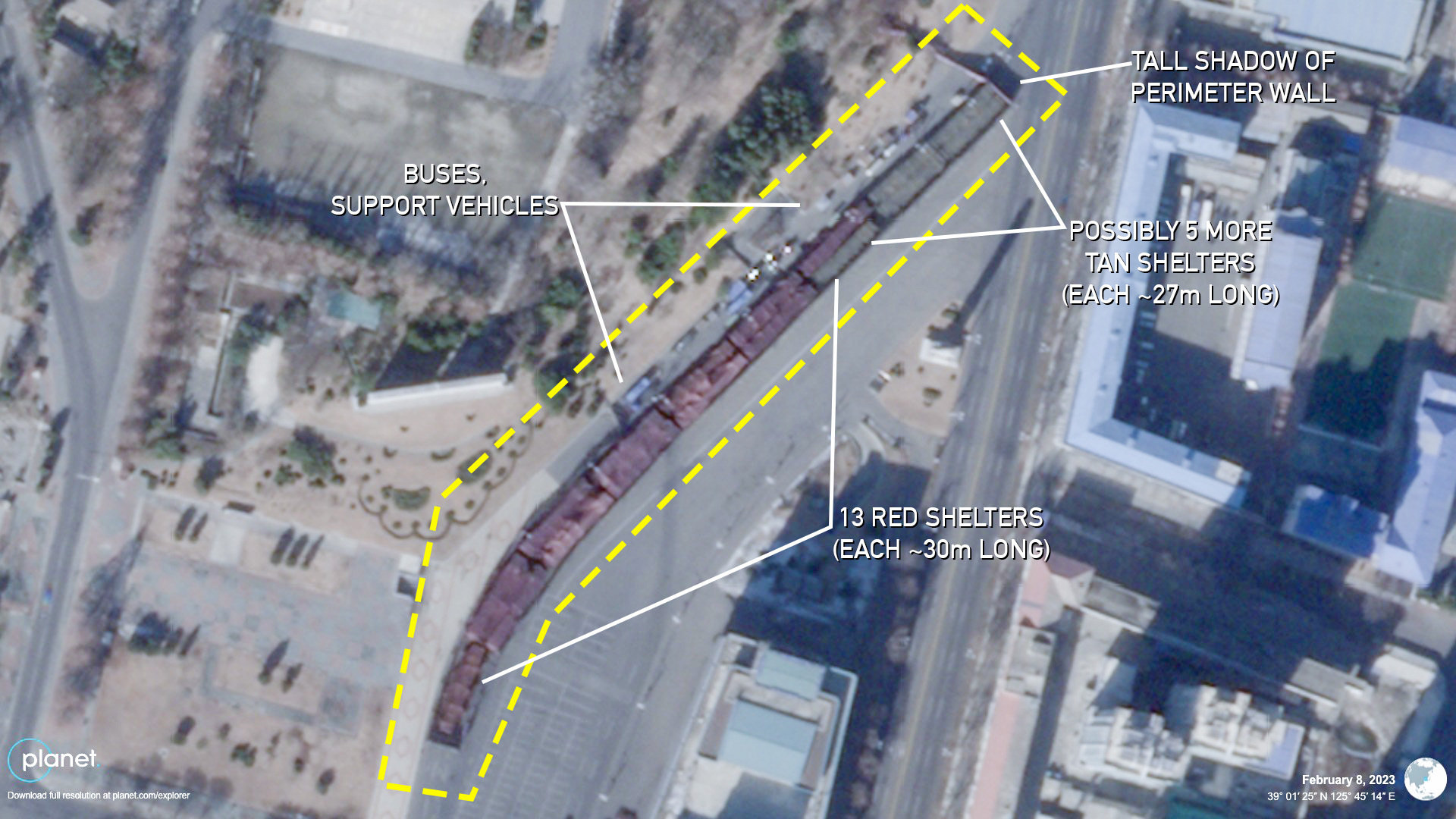 The first 13 shelters each measure around 100 feet (30 meters) — long enough to house the country’s largest ICBM, the Hwasong-17. Five more possible shelters behind these measure around 88 feet long (27 meters), and any weapons systems beneath them would likely enter the square last as the parade’s grand finale. North Korea used such a walled-off area in the same spot to hide up to four Hwasong-17s, which rolled out at the end of parades in Oct. 2020 and April 2022. The goal was likely to reduce the risk that their 11-axle TELs break down and limit unnecessary fuel use by the gas-guzzling transporters. This suggests the dozen-plus shelters in the spot on Wednesday afternoon are likely covering similarly large TELs, which are not meant to drive long distances. 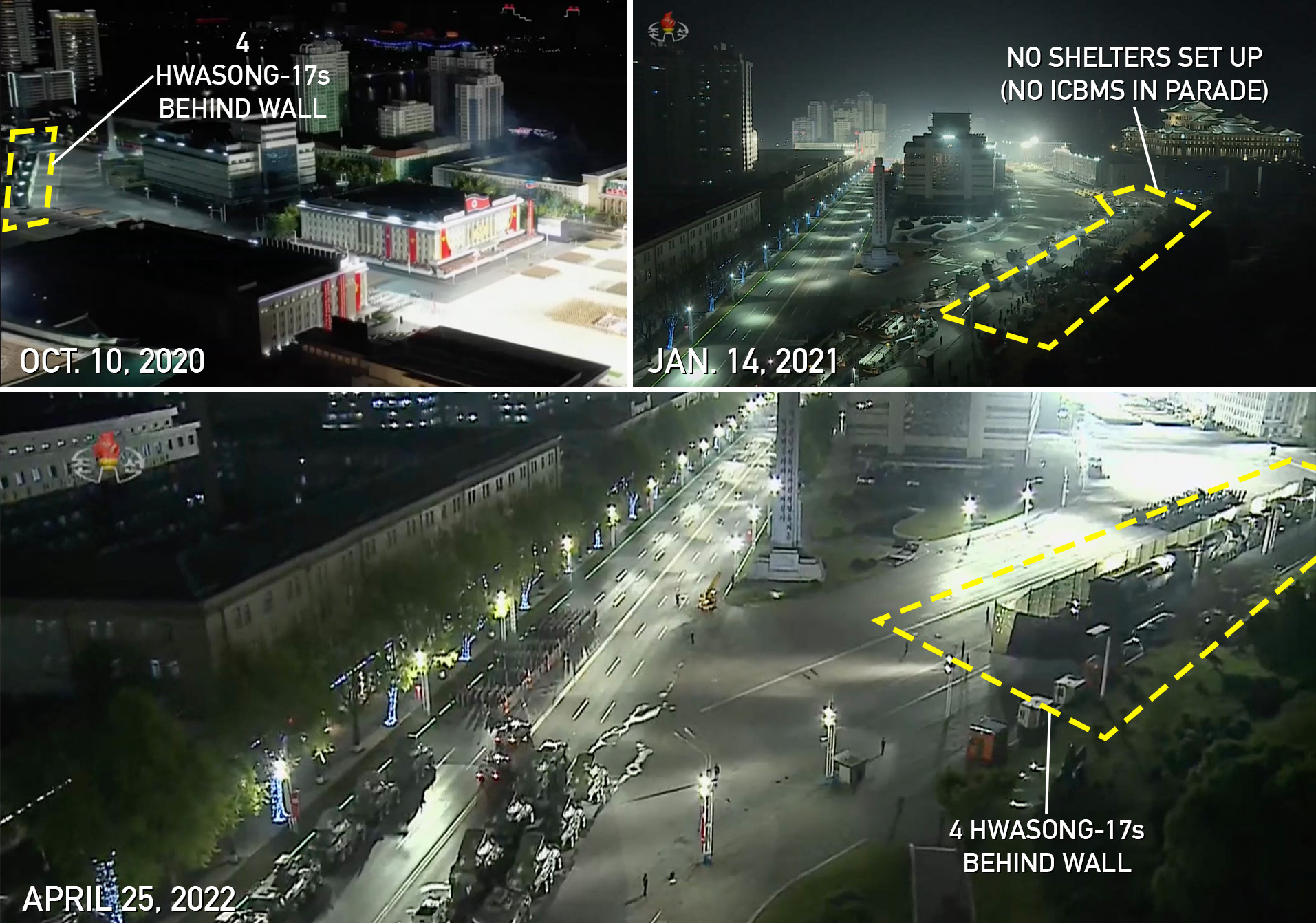 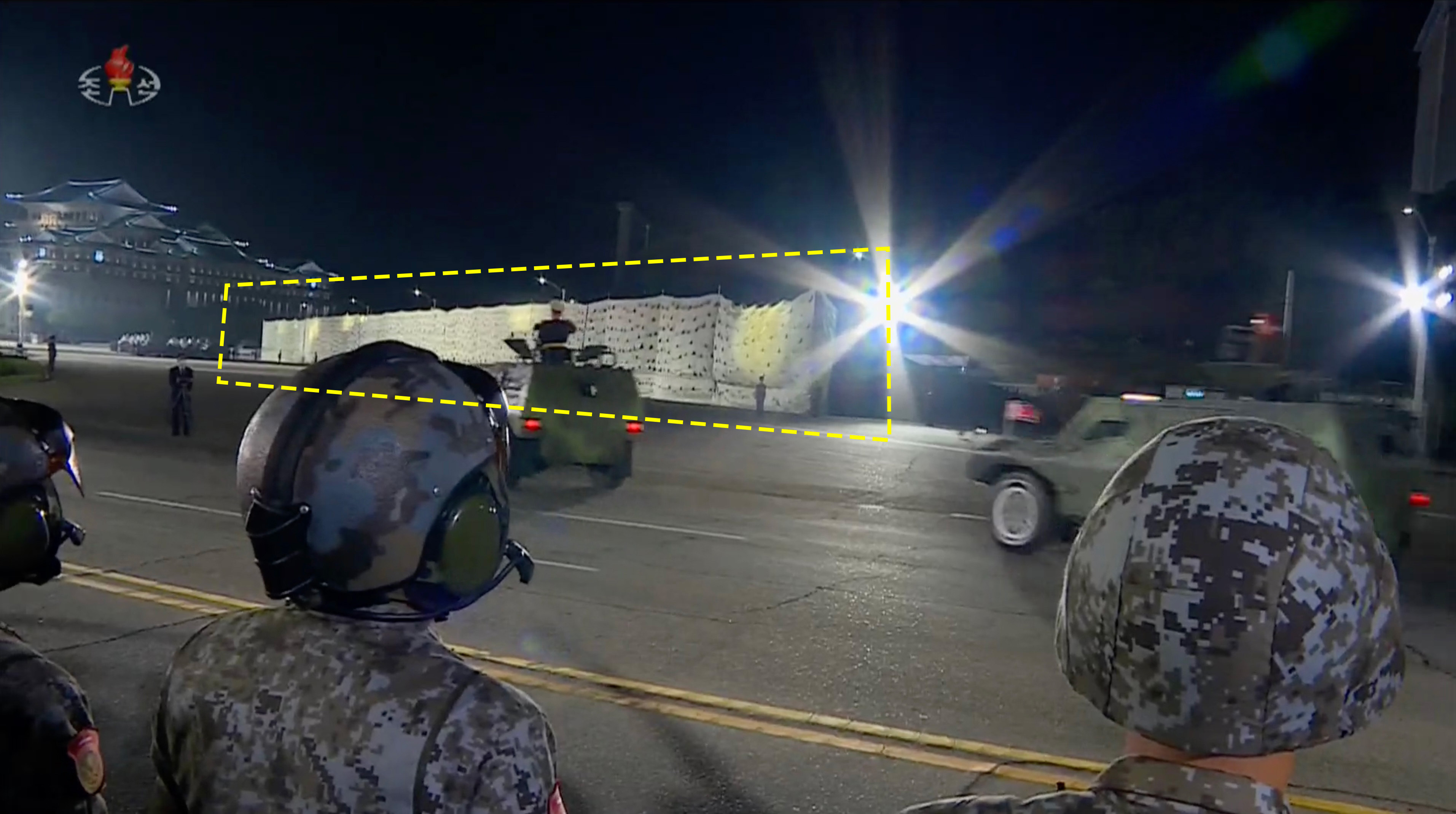 However, it is also possible that some shelters are a temporary staging area for smaller weapons such as the Hwasong-15 ICBM or Hwasong-12 intermediate-range ballistic missile (IRBM). These weapons have not appeared inside similar shelters by the square during parades in the past, instead starting from the back of the procession, but it’s unclear where they were stored during the day before those parades. The streets of central Pyongyang otherwise appeared busy with typical traffic at the time the image was taken, suggesting the hundreds of tanks, artillery vehicles and other missile systems expected at a parade would move to the area after it closed to the public. Elsewhere around the square, there were no signs of dark tire marks on the roads that would be expected to appear if a parade had already happened before dawn on Wednesday. NK News reported on jets flying in formation over the square around 1 a.m. KST the same day, but that activity now appears to have been part of last-minute dress rehearsals. 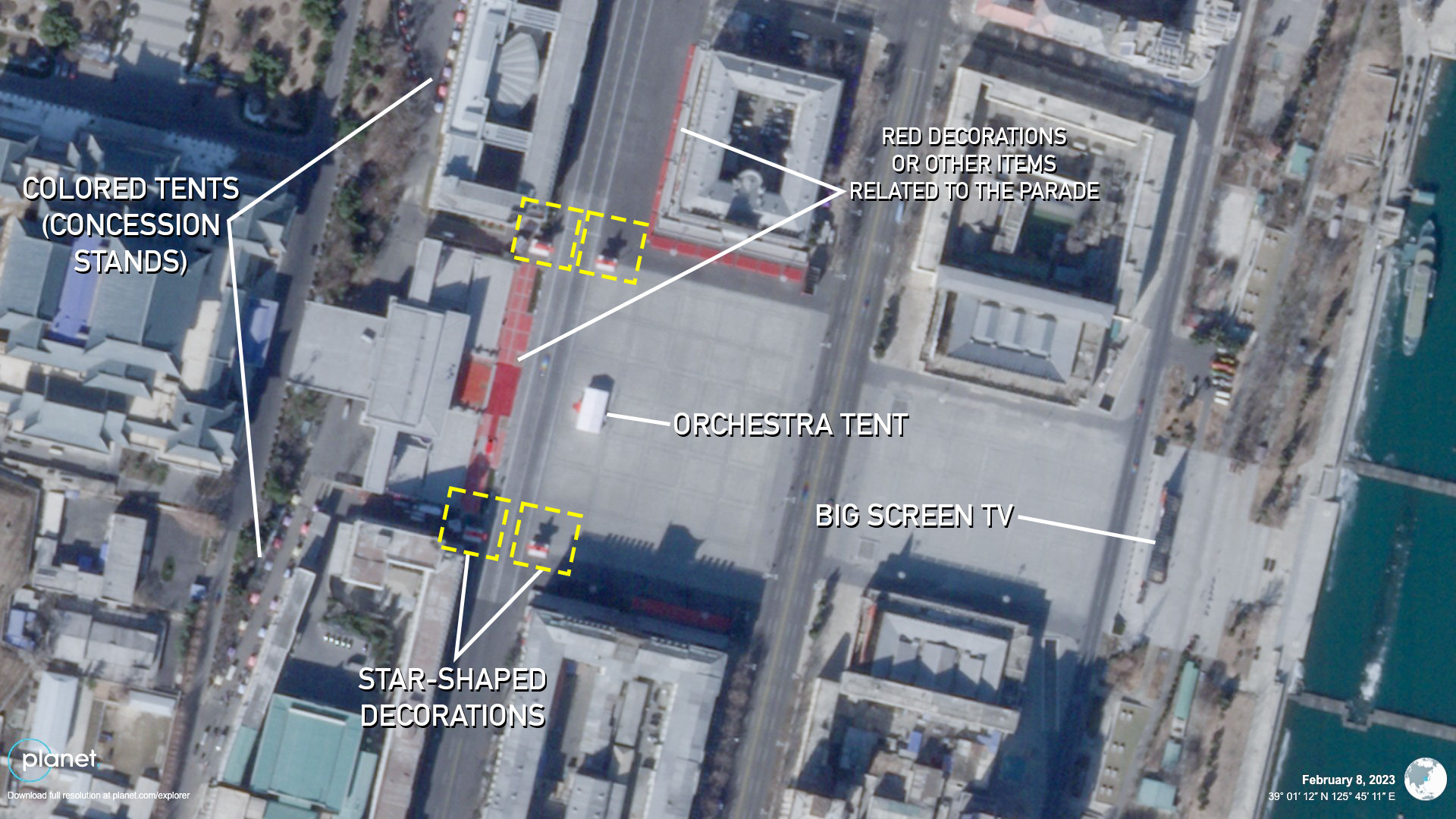 Satellite imagery taken on Wednesday afternoon also pointed to other signs of an imminent parade: The wall surrounding the orchestra tent at the front of the square appeared to have been removed, while food kiosks appeared to be set up for officials and other invited guests around the front of the Grand People’s Study House. North Korean state media is unlikely to broadcast the event live but could release the first official details of the parade as early as 6 a.m. KST on Thursday. The parade is slated to celebrate the 75th founding anniversary of the Korean People’s Army (KPA). Civilians and soldiers have appeared in satellite imagery training for the event daily since December, and have been seen spelling out the numbers “2.8” for the Feb. 8 holiday and “75” for the anniversary year in large-scale formations. Chad O’Carroll contributed reporting to this article. Edited by Bryan Betts. © Korea Risk Group. All rights reserved. |

October 28, 2026Oct 28, 2026

The ultimate resources for professionals working on North Korea
 SHARE
SHARE COPY LINK
 X
X MASTODON