  News North Korean top-priority fertilizer plant appears to be nearing completionStated aims of project which opened in mid-2017 are to boost agricultural production and “C1” chemical industry 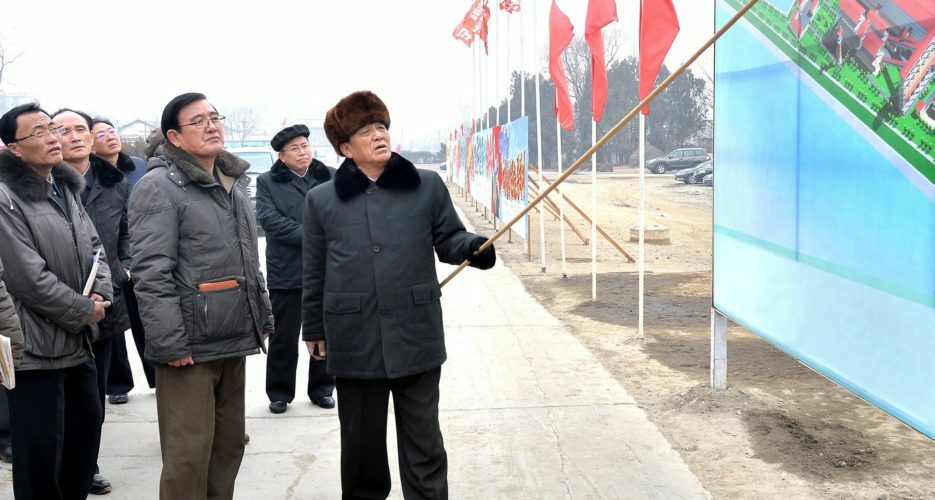 Following a week of rapid–fire opening ceremonies for some of North Korea’s top-priority construction projects, it appears another in the form of a large new fertilizer plant is also nearing completion, NK Pro analysis of recent satellite imagery shows. The Sunchon Phosphate Fertilizer Factory (순천린비료공장) — located in the city of Sunchon north of Pyongyang — is being built with the official aim of “increasing the agricultural production” of the country, though it could serve as a production base for other chemicals as well. It is one of only a handful of “important construction projects” listed in a Supreme People’s Assembly (SPA) session on the state budget last April, and is more broadly part of the state’s long-standing plans to boost its domestic “C1” chemical industry, which often appears in propaganda and leader Kim Jong Un’s New Year Addresses.  The project is being built on the site of the old Sunchon Nitro-Lime Fertilizer Factory (순천석회질소비료공장) along the Taedong river, which was demolished between late 2016 and mid-2017, according to Google Earth satellite imagery. A ground-breaking ceremony led by top official Pak Pong Ju was held in July 2017. He appears to be in charge of the project based on his many visits to the site dating back years before reconstruction began. But construction of the new factory facilities did not begin to see progress until spring of this year, medium-resolution satellite imagery provided by Planet Labs shows.  The delay could have been due to a lack of resources or issues in executing initial plans, as a report published in October in the party daily Rodong Sinmun said workers eventually overcame the challenge of a smaller-than-required construction site footprint. Many of the buildings now standing were built rapidly between April and June 2019, while further progress is evident in the late summer months and even between November 20 and the latest image taken on December 12. Over the last month, more buildings have had roofing installed and more paving of roads inside the complex appears to have been carried out, though it is unclear if more structures will be added before opening.  But reports have described the complex as including around 10 different components, including a “yellow phosphorous production site,” and facilities for “briquette drying ground and lime milk manufactory.” The Kangson Industrial Construction Company is “in charge of construction of key production processes” of the Sunchon project, while it appears to be generally managed under the Hamhung Branch of the State Academy of Sciences (SAS), according to reports in state media. This office of the SAS has been found to oversee a wide range of chemical production with applications ranging from synthetic clothing, to fertilizer, to the country’s nuclear and ICBM programs.  There is no indication the Sunchon Phosphate Fertilizer Factory will be used for purposes other than to produce fertilizer to address North Korea’s dire food shortages, but analysts have explored the possibility that plants under the C1 umbrella could be doubling as production bases for long-range missile fuel. This would be unsymmetrical di-methyl-hydrazine (UDMH), which analysts Jeffrey Lewis, founder of Arms Control Wonk, and others with 38 North suggested in late 2017 could be produced by SAS-affiliated plants. But improving agricultural outputs through enhanced fertilizer production, however — a stated goal of the project — is likely still at least one of the new Sunchon plant’s main functions.  Fertilizer imports from China spiked in 2018 to address issues in domestic production, and sanctions appear to be affecting production despite fertilizer itself not being a sanctioned item, due to restrictions on machinery and other aspects of the production process. Producing more fertilizer through the C1 process — which, simply put, involves converting simple carbon compounds into other useful products such as fuel and industrial chemicals — would be a boost to the country’s Juche or self-reliant stance, and would be another tool to sidestep sanctions. A deadline for the project’s completion has not been announced in state media, and leader Kim Jong Un has yet to publicly provide “on-the-spot guidance” at the site. Edited by James Fretwell Featured image: KCNA © Korea Risk Group. All rights reserved. |

October 08, 2026Oct 08, 2026

The ultimate resources for professionals working on North Korea
 SHARE
SHARE COPY LINK
 X
X MASTODON