  Analysis North Korean coal smuggling route to China rebounds to pre-COVID activity levelsAt least 17 DPRK-linked ships traversed Chinese waters as authorities turn a blind eye to illicit shipping 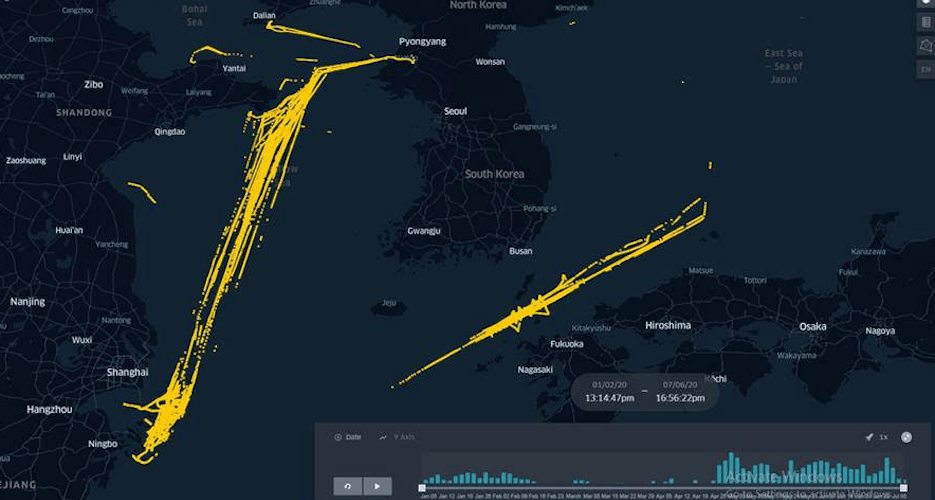 A once-busy maritime coal smuggling route between North Korea and China has returned to pre-pandemic levels of activity, a joint investigation by NK Pro and the Royal United Services Institute’s (RUSI) Project Sandstone can reveal this week. Satellite imagery and Automatic Identification System (AIS) ship tracking data show that at least 17 DPRK-linked vessels traveled between North Korea and Zhoushan, China from late April to present. Individual ships often made more than two trips. Data indicates that North Korean-controlled vessels have continued to transport export coal from the DPRK, despite official denials from Beijing and the United Nations Security Council’s resolutions deeming this activity illegal. Satellite imagery analyzed by RUSI and NK Pro also reveal the presence of Chinese maritime law enforcement vessels in clear view of the smuggling operations. A Chinese enforcement vessel sailed past the DPRK’s largest bulk carrier, the Tae Pyong, as it stopped alongside other Chinese vessels near Zhoushan in May. Data also suggests that North Korean vessels are increasingly transmitting AIS signals using their real identities, despite previously-mastered tactics to conceal their activity (AIS signals are intended to alert nearby vessels of the ship’s position and prevent collisions). The volume of North Korean traffic may indicate Pyongyang’s desire to clear a backlog of coal stocks built up during the COVID-19 crisis, which kept the country’s active fleets idled in home waters earlier in March. AIS signals from January through July, with frequency chart on bottom right showing significant drop in March-April before returning May-July | Image: RUSI, kepler.gl ENDING THE MARITIME SHUTDOWN In March, Project Sandstone published evidence of “industrial scale” sanctions breaches as North Korean-linked ships delivered coal to the Zhoushan Islands from 2019 into early 2020. That same month, the UN Panel of Experts’ annual report revealed further breaches occurring in Chinese waters, which its authorities continued to deny. However, it was the COVID-19 pandemic — not Chinese law enforcement — which ultimately halted trade in March. In conjunction with the New York Times, RUSI also revealed that North Korea had called its fleet home in response to the virus, with Synthetic Aperture Radar (SAR) imagery showing more than 130 vessels sitting idle at the country’s largest port of Nampo. At the port, North Korean authorities implemented strict measures to prevent potential COVID-19 transmission. A March NK Pro satellite analysis of the port’s terminals also showed reduced activity on the ground, including potentially-closed transportation routes.  But North Korean vessels headed directly for ship-to-ship hotspots in Zhoushan shortly after the DPRK lifted its most stringent port measures in late April, according to AIS data. By matching AIS location data with satellite imagery, NK Pro and RUSI were able to identify at least 17 North Korea-linked vessels making the journey: the K Morning, E Morning, Northern Luck, Ryong Rim (SP 9), Yon Moo, So Baek Soo (O Bae S), New Dawn (So Kwang), Caesar 1, Tian Tong (AO), Jisong 15 (JNS), Boun 1, Un Ryul, Ever Glory (Taiyang), Su Ri Bong (Hua Hai), Rina, Nam Dae Chon, and the Tae Pyong. Collectively, these vessels are capable of delivering millions of dollars worth of coal in a single trip, while several vessels in the group were observed traversing the route multiple times since April. High resolution satellite imagery from May 22 shows several North Korean vessels lingering in a remote part of the Zhoushan Islands, close to transhipment cranes likely used to transfer cargo to the Chinese lighters and barges waiting nearby.  Over half of the North Korean-linked vessels used their own identities when transmitting AIS signals. This is a significant change in behavior — previously, DPRK vessels typically worked to conceal their identities. For example, the IMO-numbered vessel, 8605727, has used both its former Chinese names (Fu Xing 12, Pu Zhou) and current Korean names (Su Ri Bong, Hua Hai). The Su Ri Bong has also been known to co-opt MMSI numbers already assigned to other ships. Such tactics help obscure the vessel’s true movements, making them more difficult to track for those seeking to monitor North Korea’s illicit activity. CHINESE INACTION Indications of illicit coal deliveries to Zhoushan first emerged in August 2019 with the UN Panel of Expert’s midterm report, which briefly noted evidence showing the presence of North Korean-linked ships carrying coal in Chinese waters. In response to UN enquiries, China stated that “the information provided by the Panel lacks timeliness and cannot lead to on-site investigation” and further added that “the information of relevant vessels is ambiguous and lacks accuracy, which does not constitute a full evidence chain or basis for further investigation.” 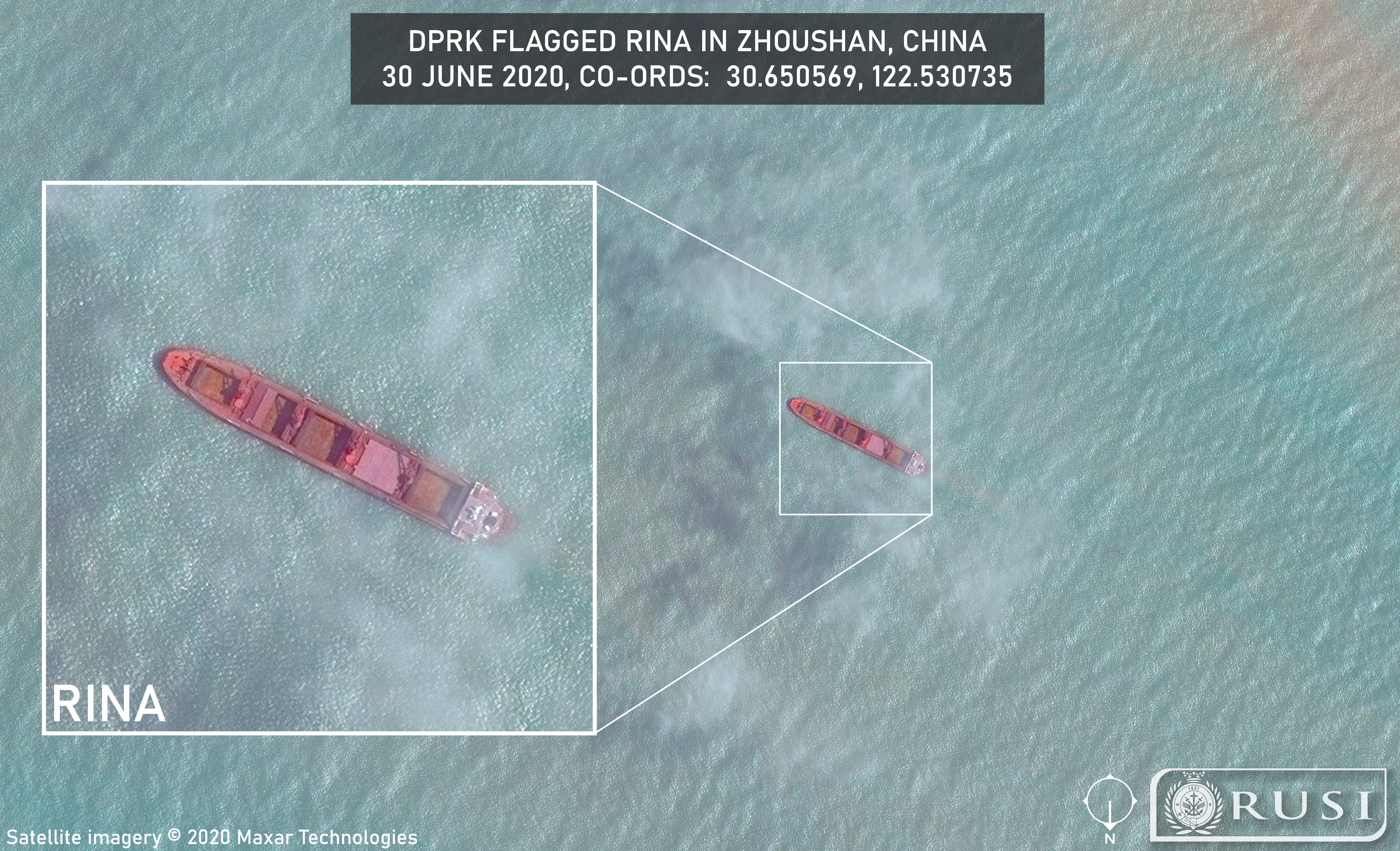 Continued evidence of Zhoushan coal deliveries published throughout 2020 — as well as the resurgence of the route following a quarantine lift at Nampo — collectively lead experts to doubt China’s claims to be fully implementing UN Security Council resolutions. “Your observation is consistent with the information which I obtained recently from a senior Japanese government official,” Katsuhisa Furukawa, a former UN Panel of Experts member, told NK Pro in an email. “According to the authority, after the DPRK resumed economic activities with China recently, the Chinese and DPRK waters are now ‘lawless’ fields, where a number of illegal activities are being undertaken in violation of the U.N. sanctions openly.” Furukawa said the level of illicit ship-to-ship transfers of coal occurring in Chinese waters was “immense.” As noted in RUSI’s March 2020 report, the waters around Zhoushan are home to significant Chinese naval and maritime law enforcement bases and assets, with coast guard and patrol vessels present in the areas also frequented by North Korea-linked vessels. “Given the recent enormous investment in China’s naval and coast guard vessels and capabilities, combined with benign export data released, one would be hard pressed to believe that such extensive illicit activity has escaped the notice of authorities,” said Neil Watts, also a former UN Panel of Experts member. Watts also suggested something Beijing would likely loathe to admit: “It would… be an admission of widespread bribery and corruption amongst coastguard and customs officials, if this was indeed the case.”  THE MORNING OF MAY 3 Data and satellite imagery reveals Chinese authorities’ willful ignorance was indeed the case for at least one coal shipment involving the Tae Pyong, North Korea’s largest and newly-acquired cargo vessel. In late April, a vessel measuring the Tae Pyong’s dimensions could be seen just off a coal export terminal in 3m resolution satellite imagery of Nampho, matching the Tae Pyon’s AIS signals detailing a location in the same area. A day later, the Tae Pyong’s AIS showed it departing Nampo, just as the matching vessel disappeared from that day’s 3m image. After leaving Nampo, the Tae Pyong sailed to Zhoushan, where it was captured in high resolution imagery on May 3 with lighters (freight carriers) in close proximity. The sides of the vessels near the holds were significantly darkened, indicating coal ash from a recent transfer. Alongside the Tae Pyong was a transloading crane, also significantly darkened, indicating it was potentially used to transfer coal from the vessel. Meanwhile, the same May 3 satellite imagery shows two Chinese Coast Guard vessels sailing away from the Tae Pyong, in clear view of both the North Korean ship and Chinese lighters laden with coal. AIS data from May 3 reveals the identity of one vessel: the Hai Xun 0743 (MMSI 413035060), a Chinese “law enforcement” ship. The Hai Xun 0743 approached and then left the Banbian Mountain Island area, where the Tae Pyong was lingering for transfers (the Hai Xun 0743 is not included in the below imagery, which shows the unknown law enforcement vessel near the Tae Pyong on May 3). 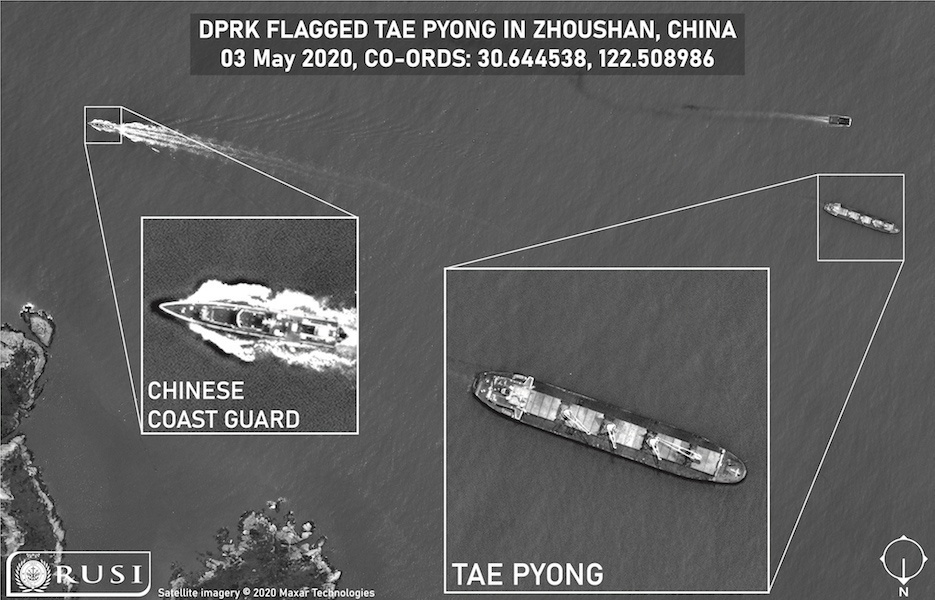 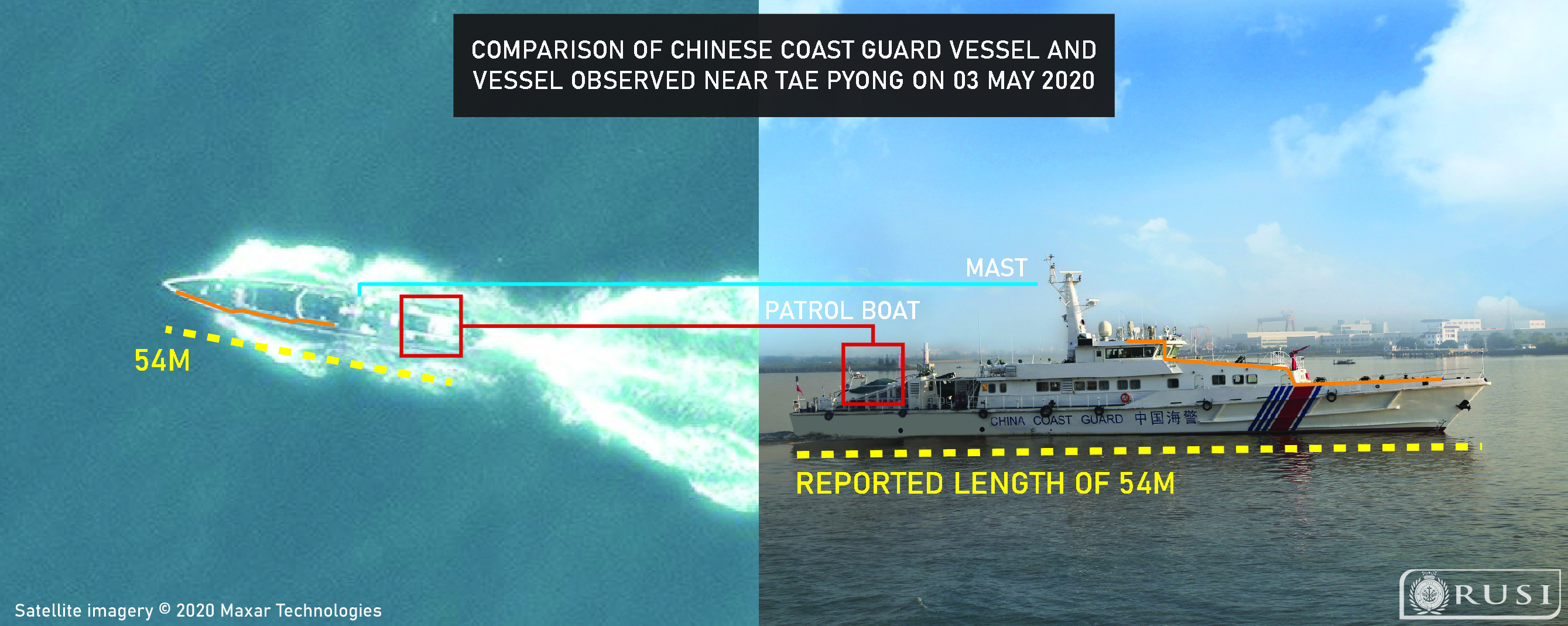 AIS data between May 2 and May 3 also show a Chinese cargo ship, the Kancheng 16 (MMSI: 413166230), stopping alongside the Tae Pyong for at least twelve hours. After the meeting, the Kancheng 16’s AIS signals showed it traveling up the Yangtze River before dropping transmissions. The Kangcheng 16’s behavior follows a pattern identified in the most recent UN Panel of Experts report, which tracked Chinese barges and lighters delivering coal to ports along the Yangtze after meeting with North Korean smugglers at sea. WHY A BLIND EYE? Former Panel of Experts members were pessimistic about the future of Chinese enforcement against North Korean maritime sanctions violations. “The Chinese government no longer takes any action and appears to have stopped apprehending or sanctioning the violators,” Furukawa said. “When one reads ‘a couple of experts are of the view this information can be further investigated,’ it suggests a polite denial and that there is unlikely to be any [Chinese] information forthcoming on the panel’s inquiries,” Watts added, referring to footnotes in the recent report. Experts also said that China’s permissiveness may be geopolitical. “The ongoing trade war and animosity between the [U.S. and China] would likely justify such a laissez-faire stance toward fulfilling its international sanctions obligations to the extent necessary,” Watts said. “[For China], the most probable scenario is that the optics of imposing sanctions measures are no longer considered a priority, and that economic interests will receive a higher priority.” Concerns seem to be reaching Japan, as well, with Furukawa stating that Tokyo is “significantly concerned about Mr. Trump’s negligence of the Korean peninsula.” “The pressure on the DPRK has been relieved significantly, which may allow the DPRK to become emboldened and resume provocations in the coming months.” Edited by Kelly Kasulis and Oliver Hotham © Korea Risk Group. All rights reserved. |

October 11, 2026Oct 11, 2026

The ultimate resources for professionals working on North Korea
 SHARE
SHARE COPY LINK
 X
X MASTODON