
  News North Korea ramps up fuel trade in second quarter from pandemic lows: ImageryActivity at coal terminals suggests sanctions violations, with oil imports from China likely increasing from last year 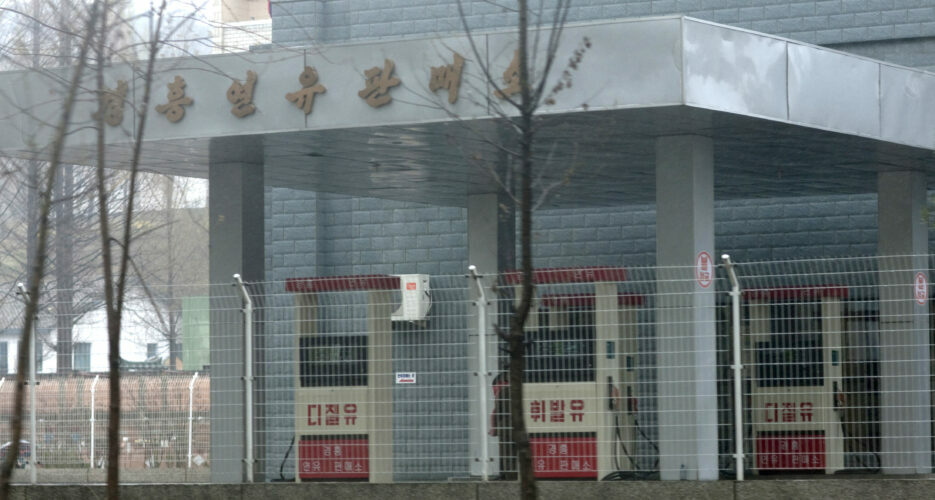 North Korea’s fuel depots were more active in the second quarter of 2022 than the same period last year, an NK Pro analysis of satellite imagery found, as the country’s trade with the outside world slowly recovers from pandemic lows. Low-resolution satellite images taken between April and June show 11 vessels docked at North Korea’s main oil terminal in Nampho, compared to just three vessels during the same period last year. Visits to the port’s coal depots also increased over the second quarter of 2021, from seven to at least 14 this year. U.N. sanctions prohibit North Korea from importing more than 500,000 barrels of refined petroleum per year and ban the country from exporting coal entirely. But low-resolution satellite imagery shows consistent activity at the country’s major coal depots in Nampho, Taean and Songrim, and ships linked to smuggling coal continue to visit Chinese ports. 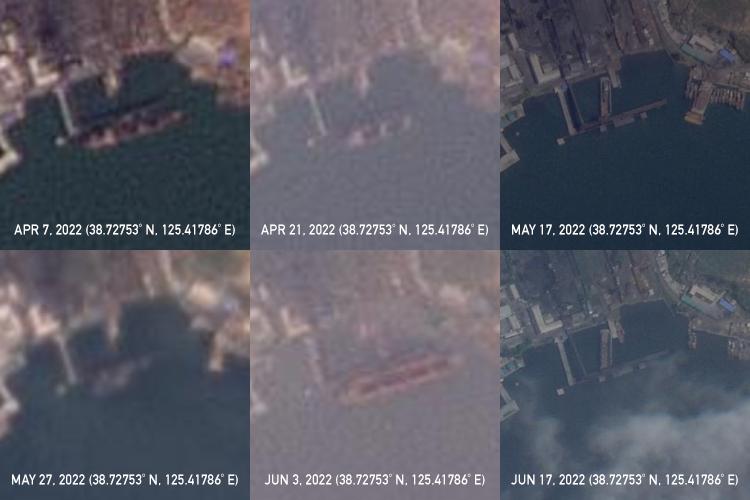 May also saw a resumption of normal traffic: While there were no observable petroleum imports or coal exports from Nampho in May 2021, at least six vessels visited coal and oil terminals in May 2022. “Despite the COVID situation, North Korean ports and particularly Nampho continue to process a significant volume of imports and exports, mostly flowing through China,” said James Byrne, the director of open-source intelligence research at the Royal United Services Institute (RUSI), which keeps tabs on Pyongyang’s fuel trade. He added that an upswing in global coal prices has greatly benefited the North Korean regime, though export levels are still below pre-COVID-19 levels. Meanwhile, an auxiliary oil terminal that went online in Oct. 2021 saw just one shipment in the second quarter, making it unclear whether the depot is still operational or is undergoing maintenance. Adverse weather limits the availability of usable satellite imagery, meaning the true number of visits to fuel depots is likely higher than what’s visible from space. TRUE FIGURES According to official U.N. figures, China imported roughly 19,000 barrels of refined oil from North Korea in the second quarter of last year, representing just 4% of the import cap. So far this year, Beijing has only submitted export figures for April, during which it shipped 7,700 barrels to the DPRK. China supplies most of North Korea’s refined and crude petroleum. Nonetheless, this quarter’s import figures are likely higher than the same period last year, as the country has gradually opened to foreign trade despite its outbreak of COVID-19. The U.N. imposed the current 500,000-barrel cap on the country’s fuel imports after North Korea tested an intercontinental ballistic missile (ICBM) in 2017, seeking to throttle the regime’s weapons programs. Although the U.N. Security Council originally resolved to tighten fuel import restrictions should Pyongyang test more long-range missiles, the international body failed to do so after North Korea launched ICBMs on multiple occasions earlier this year. Edited by Bryan Betts © Korea Risk Group. All rights reserved. |

October 08, 2026Oct 08, 2026

The ultimate resources for professionals working on North Korea
 SHARE
SHARE COPY LINK
 X
X MASTODON