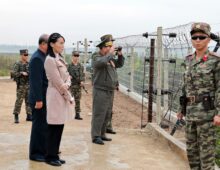
  Analysis North Korea moves to prevent the spread of coronavirus: what we know so farThe economy and humanitarian efforts will likely be affected by strict restrictions on travel in and out of the country 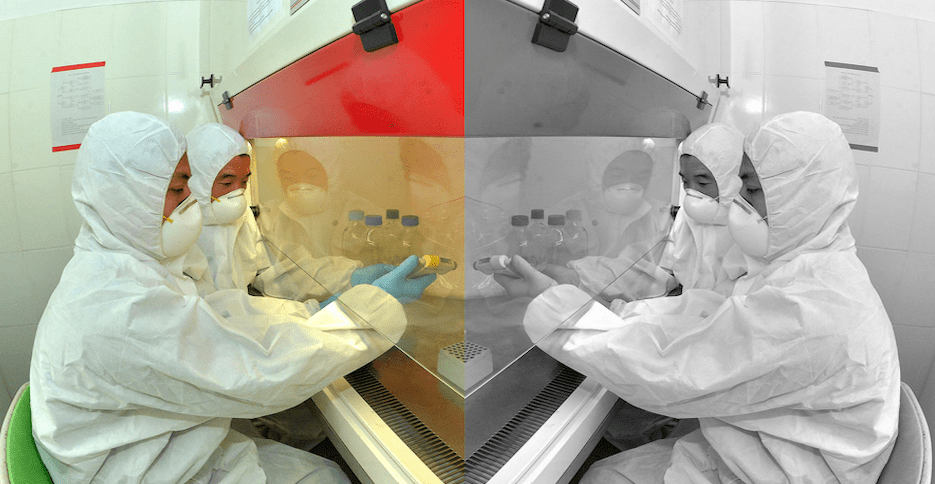 Since January 21, North Korea has introduced a series of increasingly extreme measures to combat the Chinese novel coronavirus and ensure it is prevented from entering the country. As of February 4, NK Pro understands that tourism is fully prohibited and neither non-resident NGOs nor foreign businesspeople may enter the country. North Korean citizens are also prohibited from crossing the border, either way, with exceptions granted only for the “top 1%,” according to Daily NK. However, NK Pro understands an exemption still exists for cargo to enter the country by land, from China and Russia. For those still in the country, the following measures now apply:
Given North Korea’s prior experience with Ebola and SARS, it is likely that these measures will be implemented for as long as authorities believe there is a threat of novel coronavirus entering the country. With Ebola, this was a period of approximately 5.5 months, and with SARS, a period of approximately 3.5 months. Overall, anti-novel coronavirus measures currently imposed by authorities appear to be more severe when compared to prior disease responses. With Ebola, key differences include:
With SARS, key differences include:
Assessing the impacts The North Korean government’s expansive efforts to prevent novel coronavirus from entering DPRK territory illustrates how grave a threat the epidemic could pose the nation’s dilapidated healthcare infrastructure. But as with Ebola and SARS, it is likely that the extreme nature of the measures may prove instrumental in preventing the virus from spreading into DPRK territory. However, there could be long-term consequences for a wide variety of actors both inside and outside of the country.  North Korean citizens DPRK nationals both inside and out of the country are likely to experience a wide range of impacts from the measures. Market prices – Already, reports are emerging which have stated that rises in market prices are occurring in borderlands areas due to restrictions on travel between the two countries. Furthermore, it is said that fears are increasing that markets could be closed down and sales of live animals prohibited as extra precautions to prevent an outbreak in DPRK territory. Internal travel – Another likely area of consequence, not yet reported from in-country sources, relates to potential domestic travel restrictions. Early during the Ebola-outbreak of October 2014, DPRK authorities reportedly imposed limits on travel permits for people from regional areas to Pyongyang. Those on personal business were allegedly banned from visiting the capital entirely, while those on official business were only allowed if they received an official health certificate. Workers in China and Russia – In particular, North Korean workers and business people in China may encounter significant problems returning home. Daily NK said on Tuesday that only the “top 1%” of officials and foreign currency earners were being allowed to cross the border and engage in quarantine processes. Furthermore, given the suspension of all flights and international rail, there is also the question as to whether the remaining 1,000 North Korean workers still believed to be in Russia will be able to get home. Delegations overseas – Given the measures currently prohibit all rail and air access to and from the DPRK, delegations of even high-level officials overseas will face significant travel problems. This could impact, for example, the DPRK Vice Foreign Minister for Europe’s forthcoming trip to the Munich Security Forum in mid-February. Financial impacts for host organizations, individuals – Given the surge in tourism from China last year, a sustained suspension of inbound visits will have a significant impact in the North. At a macro-level, state tour companies, hotels, shops, and restaurants will encounter significant financial turbulence if the restrictions prevail. At the micro-level, individuals working as guides, cleaners, wait staff, and drivers will also lose out on tips and other foreign currency earning opportunities derived from interaction with such visitors. Given the growth of this industry over the past 24 months, the impacts should not be underestimated. Foreign residents and visitors Foreign nationals who work on DPRK issues from both inside and out of the country are also likely to experience a wide range of impacts from the measures. Decline in humanitarian programming – NK Pro already understands that a range of humanitarian programming conducted by visiting NGOs has been abandoned until the end of April, at least, with possibilities of extension should the virus continue spreading in neighboring PRC. For international organizations and NGOs permanently operating in-country, it’s possible a reduction in the number of staff over the coming months may occur in the event departing personnel are unwilling to engage in the lengthy quarantine procedures mandated on any return travel back to North Korea. Shrinking embassy, humanitarian resources – Given many foreign diplomats and resident humanitarian staff use the air and rail route to transport cash for daily operations, it’s possible financial shortages could soon occur which threaten aspects of day-to-day activities. Furthermore, the scope of inbound humanitarian supplies through these two routes will likely to be constrained as the number of visitors sharply decreases in the weeks and months ahead. Depending on how long exemptions exist for land-based imports of cargo last, this could also magnify stresses on the DPRK public health system. Significant hurdles for business sector – Foreigners working with or in partnership with DPRK business entities are likely to encounter significant friction should the restrictions last into the medium to long-term. These could impact important maintenance for UNSC-authorized joint ventures like the Egyptian-backed Koryolink cell phone network, as well as prevent visits by the scores of unauthorized Chinese-DPRK joint ventures currently thought to be active in the country. For those foreign business partners working in the tourism sector, firms specializing in travel to North Korea like Koryo Tours, Uri Tours, and Juche Tours will be among those most affected. In addition, the measures will also prevent the much larger and more lucrative Chinese tourist market from coming for a sustained period of time, though it is unclear how diversified providers in this area are. Inter-Korean impacts, delays – Already in January measures were imposed which add further friction to the remaining points of inter-Korean cooperation. North Korea decided to postpone plans to demolish South Korean-owned facilities at the Mount Kumgang resort, South Korea’s Ministry of Unification (MOU) said on January 30, due to concerns about visiting ROK officials posing novel coronavirus transmission risks to the DPRK. A day prior, the MOU revealed that it would be temporarily suspending activities at the jointly-run liaison office at Kaesong as a separate precautionary step. The development followed ROK officials trying to visit the facility being turned away at the border just a day before. No foreign journalism? – Another area likely to be affected will be journalism in the DPRK, with foreign bureaus such as AFP, AP, Kyodo, Tass, and Xinhua likely to be prevented from sending foreign staff in and out of the country in the weeks and months to come. Furthermore, the possibility of large press tours taking place in April (one of the traditional periods of the year for large delegations to visit) seems highly unlikely.  What’s next? Evidence shows that restrictions currently imposed by the DPRK are stronger than during prior disease outbreaks, such as SARS and Ebola. Furthermore, given that the novel coronavirus is geographically emanating adjacent to the DPRK (in comparison with Ebola) and that global virus infection numbers are growing rapidly (in comparison with SARS), it is possible that aforementioned restrictions could be imposed for a longer period than during the two prior responses. As a result, there are a number of broader consequences that could soon impact the DPRK in the weeks and months ahead:
Overall, though, the biggest area of risk for the North Korean authorities will relate to any sustained halt of tourists from neighboring China. A key cash cow between 2018-2019 for authorities in the DPRK, this could have a noticeable impact on the North Korean economy if it prevails. And in the event that hysteria surrounding the virus continues to grow, there is a small possibility that cargo deliveries from China could also be suspended, on a temporary basis at least. Given the PRC accounts for the vast majority of trade between the two countries, this would naturally have a significant impact. Edited by James Fretwell and Oliver Hotham © Korea Risk Group. All rights reserved. |

October 24, 2026Oct 24, 2026

The ultimate resources for professionals working on North Korea
 SHARE
SHARE COPY LINK
 X
X MASTODON