  Analysis Imports start to accumulate at North Korea’s massive new disinfection complexHigh-res satellite images show trains unloading goods from China, revealing details about strict COVID-19 import scheme 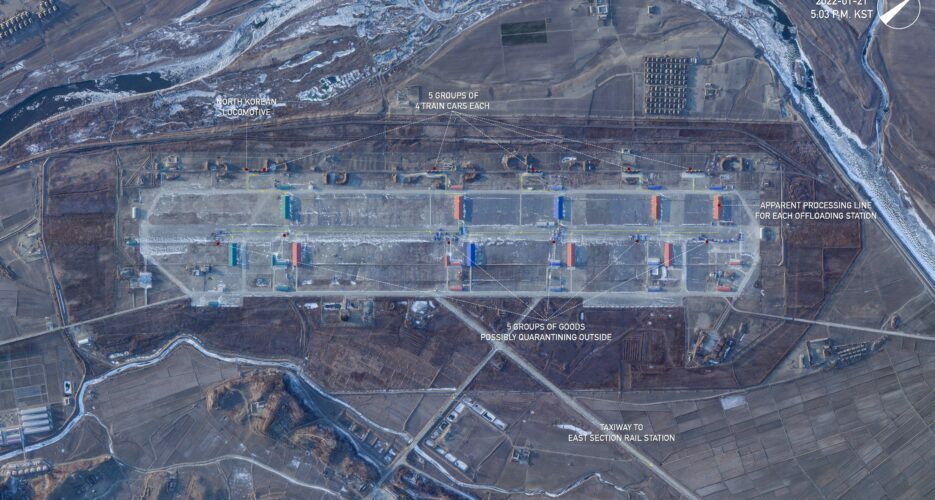 North Korea appears to have begun disinfecting and quarantining goods at its border with China days after rail trade between the two countries resumed last week for the first time in over a year, NK Pro analysis shows. Planet Labs satellite imagery reveals a complicated labyrinth of warehouses, platforms and staging areas set up for long-term disinfection and quarantine of cargo entering North Korea from the Chinese border city of Dandong. After several trains have crossed the DPRK-China border, items do not appear to have exited the airport-sized processing complex yet, with quarantine procedures likely to take several weeks. North Korea accepted the first train of imports on Jan. 17 after more than 17 months, and South Korea’s intelligence agency reportedly assessed that trains carrying around 20 cars of goods had arrived “every day” since. Lower-resolution imagery shows train cars at the disinfection complex’s five offloading stations on Sunday, suggesting shipments did indeed continue through the weekend.  HOW THE PROCESS WORKS Imagery shows for the first time details about how the world’s strictest COVID-19-related import scheme will work. A Chinese locomotive first picked up empty train cars from North Korea on Jan. 16. The next day, the Chinese locomotive carried cars full of goods to the DPRK across the China-North Korea Friendship Bridge and soon after brought back more empty cars to China for loading, establishing a routine that appears to have continued. Once a North Korean locomotive delivers the full cars to the disinfection complex at the repurposed Uiju airport 8.7 miles (14 kilometers) away, the train cars appear to split into groups of four along five separate offloading platforms, adjacent to five 29,000-square-foot (2,700-square-meter) warehouses, according to satellite imagery. New high-resolution Skysat imagery — taken Jan. 21 at around 5 p.m. KST — further reveals that offloaded items are processed through adjacent large warehouses quickly before being moved out of doors on the opposite ends of the warehouses and stored outside in their own cordoned-off pools on the airport’s main runway. The time it takes for workers to process the items through these warehouses before moving them outside is still unclear, but the imagery suggests it takes one or two days.  It appears that workers do not immediately move the items into a second row of five warehouses of the same size on the opposite side of the runway, according to NK Pro analysis of daily lower-resolution imagery taken over the last week. This suggests the items could be quarantined outdoors, just as containers and other items are at North Korea’s Nampho seaports. This would theoretically increase the capacity of the complex in terms of incoming goods, meaning it could continue to accept daily incoming shipments without being overwhelmed before the first shipment that arrived on Jan. 17 completes its disinfection process and is ready to leave the complex. However, this leaves questions about the purpose of the second row of warehouses, whose entrances all appear to be protected by barriers on the main runway nearby where the new groups of items appear to be quarantined. They may be used to perform a second round of disinfection before goods are allowed to exit the complex, or be reserved for quarantining sensitive items. A section of the airport connected via a taxiway around 1.4 miles (2.25 kilometers) to the east, which features warehouses, a rail line and loading platform, did not appear busy in satellite images taken in the last week. This section was built later than the rest of the complex last year, and may be where items are shuttled to after clearing disinfection and quarantine. Trains may come into the freight loading station in this area to take goods away to Pyongyang and other parts of the country. There is only one train line connected to the main part of the complex, though authorities may consider that line unsuitable for taking away “clean” goods since it receives unprocessed train cars. Trucks may take some items out of the complex for delivery, but rail is the more efficient method for moving large volumes of goods cross country. Edited by Arius Derr © Korea Risk Group. All rights reserved. |

October 25, 2026Oct 25, 2026

The ultimate resources for professionals working on North Korea
 SHARE
SHARE COPY LINK
 X
X MASTODON