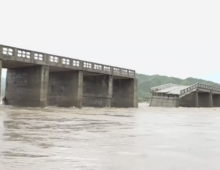



Flooded homes, factories and streets: The scope of Typhoon Maysak’s damage
Widespread flooding evident across key DPRK city, including near Wonsan-Kalma airport and delayed beach resort project
 SHARE
SHARE COPY LINK
 X
X MASTODON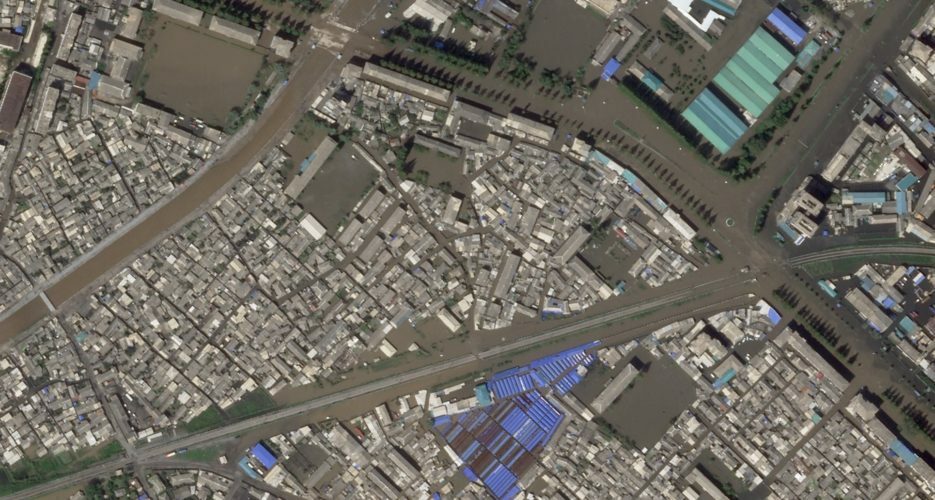
Typhoon Maysak flooded main streets and submerged hundreds of homes, factories and other buildings in water throughout the North Korean city of Wonsan on Thursday, Sept. 3, according to an NK Pro analysis of Planet Labs satellite imagery.
The satellite photos, taken just hours after the typhoon passed through the country, also show flooding in crop fields and in areas surrounding the Kalma Airport, including its runways. The storm, called “Typhoon No. 9” in North Korea, may have also affected the Wonsan-Kalma beach resort project.
The resort — a massive complex with thousands of hotel rooms, malls and entertainment facilities that was scheduled to open in April — was quietly and indefinitely delayed amid economic problems and the global COVID-19 pandemic.
North Korean state television began to show water accumulating on the streets of Wonsan just after 12:00 a.m. on Sept. 3, and on-the-ground broadcasts showed a large intersection in front of the Wonsan Department Store completely flooded by 6:00 a.m.

Korean Central Television (KCTV) also showed major flooding in the early hours of Sept. 3 in Thongchon, Tanchon and Kosong counties, as well.
Wonsan reportedly received 246 millimeters (9.6 inches) of rain by 7:00 a.m., while the town of Munchon just to the north received 242 millimeters (9.5 inches), according to statistics aired on KCTV from the DPRK’s State Hydro-Meteorological Administration. Further south, Kosong appeared to be the worst hit, with 288 millimeters (11.3 inches) of rainfall.
Notably, state television stopped broadcasting updates on Typhoon Maysak around noon on Thursday, just as the storm was expected to hit several major northeastern coastal cities.
As of Friday afternoon, other state media outlets had yet to release more information on storm damages. Meanwhile, updated satellite imagery of much of North Korea’s east coast was not available.

But given the precipitation totals released by state media on Thursday and the widespread flooding in Wonsan, it is likely the typhoon also seriously damaged other areas of the country.
So far, State media has not released casualty or missing persons figures from Typhoon Bavi last week, nor from other flooding last month. But at least 22 people died and four were missing as of mid-August, according to the International Federation of Red Cross and Red Crescent Societies (IFRC). The North Korean government reportedly relayed these numbers to the IFRC after heavy rains.
Below are additional high-resolution satellite images of the storm’s effects in Wonsan, provided by Planet Labs and taken at 2:00 p.m. on Sep. 3:


Edited by Kelly Kasulis