  News Destroyed, rebuilt and flooded again: North Korean homes ruined by 2020 typhoonsFlooding in newly-built villages shows pitfalls of North Korea’s rebuilding efforts 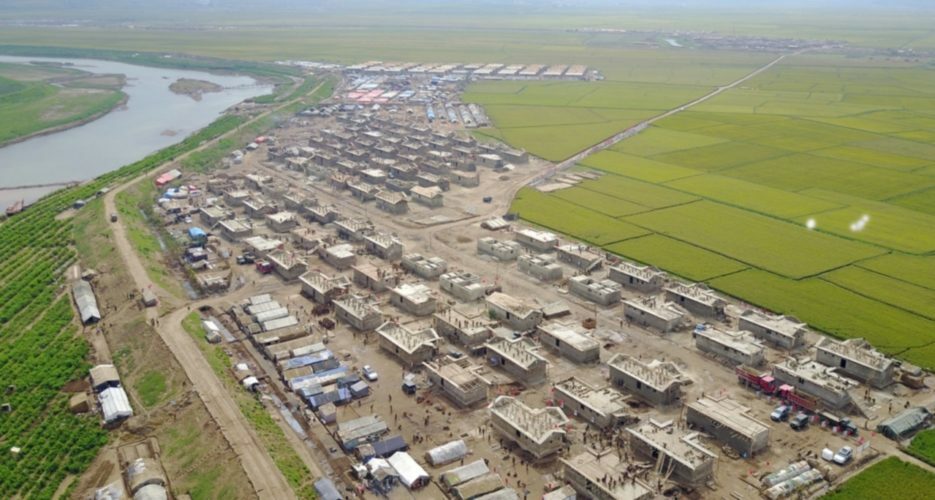 Typhoons and floods destroyed thousands of homes in North Korea this summer, spurring Kim Jong Un to order the military and even Pyongyang’s elite party members to frantically rebuild dozens of villages nationwide. But many of the homes that Typhoons Maysak and Typhoon Haishen flooded in early September were actually newly-built only four years ago, according to satellite imagery of North Hamgyong province, which is near the border with China. This suggests that North Korea’s latest reconstruction efforts are only a temporary fix in some cases, especially as the country appears to be building new homes inside the same flood zones that were in a state of disaster last month.  DISPLACED AGAIN After Typhoon Lionrock caused severe flooding in late 2016, North Korea built around 100 new housing developments in the Hoeryong, Musan and Yonsa areas of North Hamgyong province. The housing developments ranged in size from a few dozen homes to several hundred each. They were often built near the old flooded buildings and along the same rivers — apparently without proper riverbank reinforcements or other new precautions to guard against future flooding, as the latest destruction shows. Other clusters of homes were built higher up, away from the rivers, which may have saved them from being swept away last month. Now, following Typhoon Maysak’s landfall on Sept. 3, at least 21 of these developments appeared submerged in overflowing river waters, according to Planet Labs satellite imagery.   In at least four of these cases, homes appeared to be completely destroyed or washed away. In many other cases, river waters reached the edge of new developments, though image resolution was insufficient to determine if they were in fact submerged. Flooding also appeared to wash away groups of older homes near some of the new developments.   State media has not singled out this region for new reconstruction as part of its current campaign, where elite party members from Pyongyang have been sent to North and South Hamgyong provinces to participate in the building. Satellite imagery taken on Sept. 28 covering much of Hoeryong, Musan and Yonsa also does not show evidence of new housing developments being built, as is the case in over a dozen counties across the country.   In fact, much of the region’s flooded areas still did not seem cleaned up by the end of September, while washed-out roads and broken bridges have yet to be repaired. So, what is to become of the newest scores of houses and apartment blocks being built with an apparently similar lack of planning? These construction projects have rapidly-approaching deadlines, slated for either the Oct. 10 founding anniversary of the ruling party or the Eighth Party Congress in Jan. 2021. Take Unpha county for example, where Kim Jong Un already visited twice — first in the immediate aftermath of the early-August flooding, and again in early September to inspect new housing under construction there. In the below image showing new neighborhoods under construction in Unpha, many homes are being built on top of the same land where houses were destroyed in August. In some cases, they’re being built even closer to the riverbanks than the previously flooded homes.  In recent months, state media has heavily promoted ongoing work to reinforce riverbanks to improve flood preparedness, including in Unpha. But the quality and effectiveness of this construction — and indeed the distribution — has yet to be revealed. Some new neighborhoods may survive future flooding if they were built higher up, away from undeveloped riverbanks. State television also recently showed off other helpful features in new housing developments, such as drainage ditches surrounding buildings in Kumchon and Phyongwon. But the fact that new developments are being built quickly in the footprint of villages flooded earlier this summer raises the possibility that the projects are merely temporary fixes. North Korea could be taking this route to cope with a shortage of resources or a lack of ability to properly map out flood zones and build in safe areas. Kim Jong Un also criticized North Korea’s construction practices during a visit to another reconstruction zone in Kimhwa county this week. He said that the building materials industry needs to “actively develop and produce modern and efficient construction equipment and tools,” and that construction sites need to improve “mechanization.”   However, Kim did not mention any issue with the location of the new apartment blocks in Kimhwa, which are being built in place of apparently-destroyed homes in the town center, according to Planet Labs imagery. Rows of small homes nearby, on the other hand, are being built further away from the river. With North Korea suffering major damages from typhoons almost every year recently, and with experts warning of an uptick in natural disasters due to worsening climate change, Kim Jong Un will have to move beyond temporary fixes if he is to avoid another disruptive reconstruction speed battle in the coming years. That is, if the ruling party sees no value in such campaigns, and if Kim can secure sanctions relief to begin importing better building materials. Edited by Kelly Kasulis © Korea Risk Group. All rights reserved. |

October 25, 2026Oct 25, 2026

The ultimate resources for professionals working on North Korea
 SHARE
SHARE COPY LINK
 X
X MASTODON