
  News Construction resumes on China-North Korea island EDZ: satellite imageryNew work may be part of joint initiative with Chinese companies, comes despite sanctions and COVID-19 restrictions 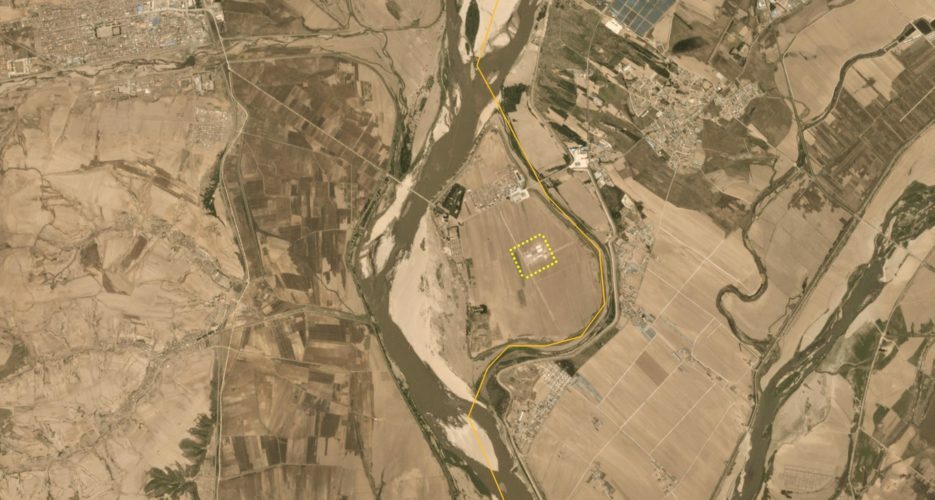 Construction inside a North Korean economic development zone (EDZ) on the border with China has seen renewed progress in recent weeks, NK Pro analysis of satellite imagery revealed, following an apparent pause over winter. The number of what appear to be industrial buildings on Ryuda island (류다섬/柳多岛) has doubled to four since construction resumed around the beginning of May, according to Planet Labs medium-resolution daily satellite imagery. NK Pro was first to report on the start of construction in what the North calls the Kyongwon Economic Development Zone (경원경제개발구) last fall, revealing extensive and active Chinese connections. One Chinese company made ambitious computer graphic mock-ups for a modern multi-industry complex, other companies based across the border in Hunchun have registered in recent years with names linked to the island, and local Chinese government organs have released extensive plans for the zone. The new construction comes as North Korea maintains heavy restrictions on cross-border trade and travel under COVID-19 prevention measures, and as new joint venture EDZ initiatives on DPRK soil remain prohibited under UN sanctions. Modest progress Construction on two rectangular buildings measuring around 50×25 meters each began last October, but the area was never paved over and work halted from mid-November through this past April, according to Planet Labs imagery. The images show that preparations resumed in mid-April before construction on two more buildings of the same size, situated close to the previous two in a two-by-three grid, began around the start of May. Daily imagery from the past week shows activity has continued through May 30.  A May 13-dated high-resolution satellite image provided by EOS Landviewer and reviewed by NK Pro revealed the buildings are each likely only a few stories tall, pointing to their potential use as small warehouses. The image showed two additional smaller buildings under construction, at least one large crane in use, and only a handful of temporary structures on the worksite. The construction so far has yet to make a footprint beyond a small patch of land in the center of the island, and there are no signs of the kind of large-scale work needed to realize the entirety of those ambitious plans. Construction on a new grid of roads resembling those in the Chinese company’s 3D blueprints, which began in October 2017, have also yet to be paved or expanded, according to the recent imagery. It is unclear whether the new construction is being undertaken by North Korean workers or an interested Chinese party. It is also possible that the new work is part of a new but smaller-scale operation after years of inactivity on the larger project, perhaps due to sanctions and/or trouble finding investors. The island was promoted by a Chinese company in 2017, for example, as a prime spot for sea cucumber cultivation, showing off mockups in a flashy video presentation of extract products for medicinal use and a brick-and-mortar shop.  Meanwhile at the main cross-border bridge nearby at the eastern edge of the shared DPRK-Chinese border, satellite imagery shows there has been little if any progress since last fall on a new large Chinese customs complex that has been under construction since 2017. All the way on the western edge of the shared border, however, is a much more significant example of the kind of large-scale construction intended to improve cross-border trade, making swift progress in recent months. Planet Labs satellite imagery taken in recent weeks shows that paving of the DPRK-bound side of a new highway to finally connect the New Yalu River Bridge to North Korean roads has nearly completed. By the end of May, only a small section was left to be paved where the new road meets the existing North Korean highway, while paving of the China-bound side has yet to begin, according to the imagery. But plans for another similarly-ambitious EDZ on the North Korean side — said to be fully Chinese-owned — have yet to materialize near the bridge despite the Chinese company’s claims of imminent progress last year, though these may still appear alongside the new highway and expanding construction preparations there. Edited by Oliver Hotham © Korea Risk Group. All rights reserved. |

October 27, 2026Oct 27, 2026

The ultimate resources for professionals working on North Korea
 SHARE
SHARE COPY LINK
 X
X MASTODON