  Analysis Chinese ships loiter near site of ship-to-ship transfers in North Korean watersActivity appears far from usual transfer sites, while anomalies in at least two ships’ broadcasts point to tampering 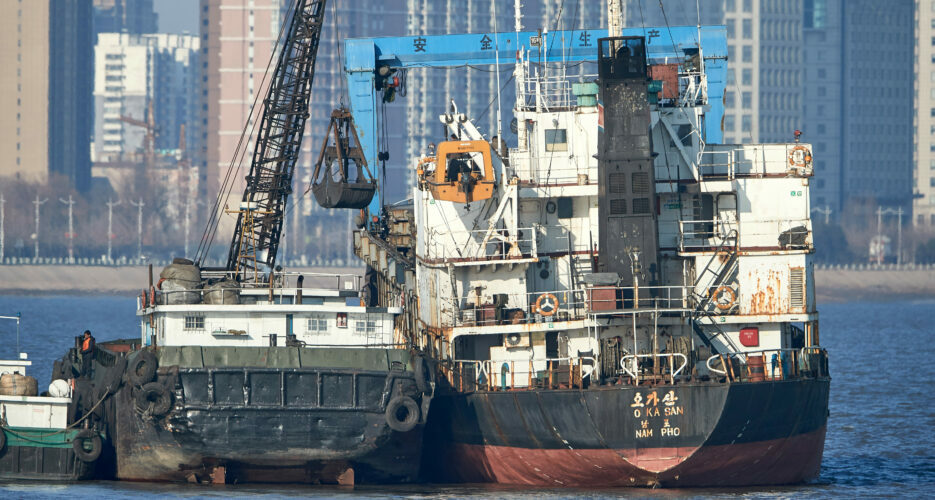 Chinese ships have congregated in North Korean waters unusually far from the country’s main port of Nampho in recent weeks, ship-tracking data and satellite imagery show, while several ship-to-ship transfers appear to have taken place in the area. The activity suggests vessels are assembling outside established staging areas to avoid detection, as ship-to-ship transfers are a key part of the DPRK’s sanctions evasion strategy. According to maritime tracking database MarineTraffic, at least three Chinese-flagged ships — the Shan He, Jin Ye 18 and Ciyan 178 — anchored close to one another roughly 35 nautical miles (56 kilometers) from Nampho’s lock gates in late July and early August. Since COVID-19 began, ships have typically quarantined outside Nampho for several weeks before entering, but this particular stretch of water is nearly two dozen miles (39 km) from the main waiting area. Moreover, satellite imagery shows no less than 11 vessels (some roughly 330 feet in length) in the area, despite only four appearing via automatic identification system (AIS) broadcasts. 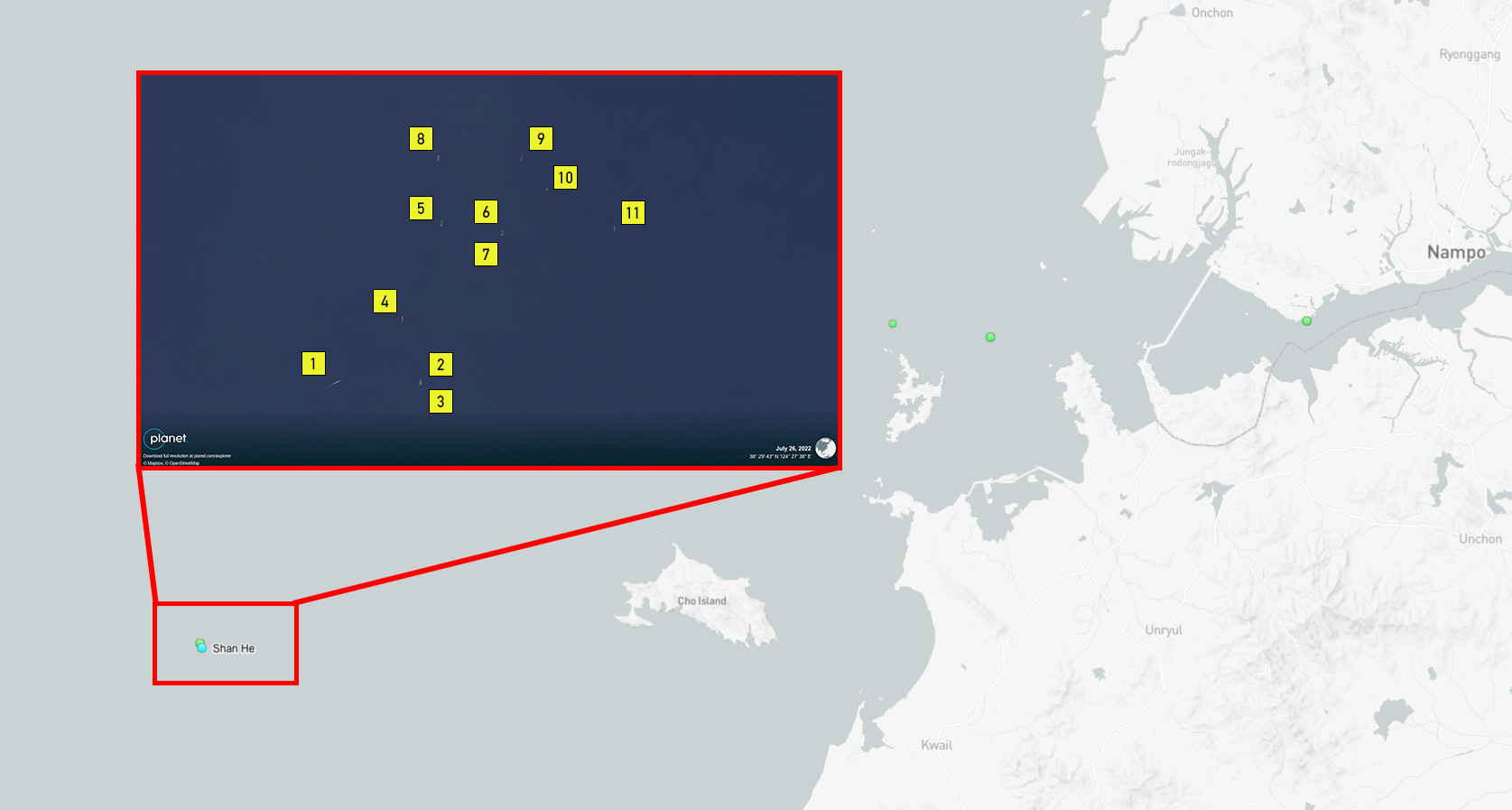 The presence of the additional vessels suggests some have switched off their AIS transponders, atypical and dangerous behavior for large ships in close proximity to other vessels. Satellite imagery between January and August this year further shows that ships only began congregating in the area around mid-June, and that several apparent ship-to-ship transfers took place. But a lack of low-resolution satellite imagery since July 26 makes it difficult to say whether ship-to-ship transfers involved the three Chinese-flagged ships or other unidentified vessels. 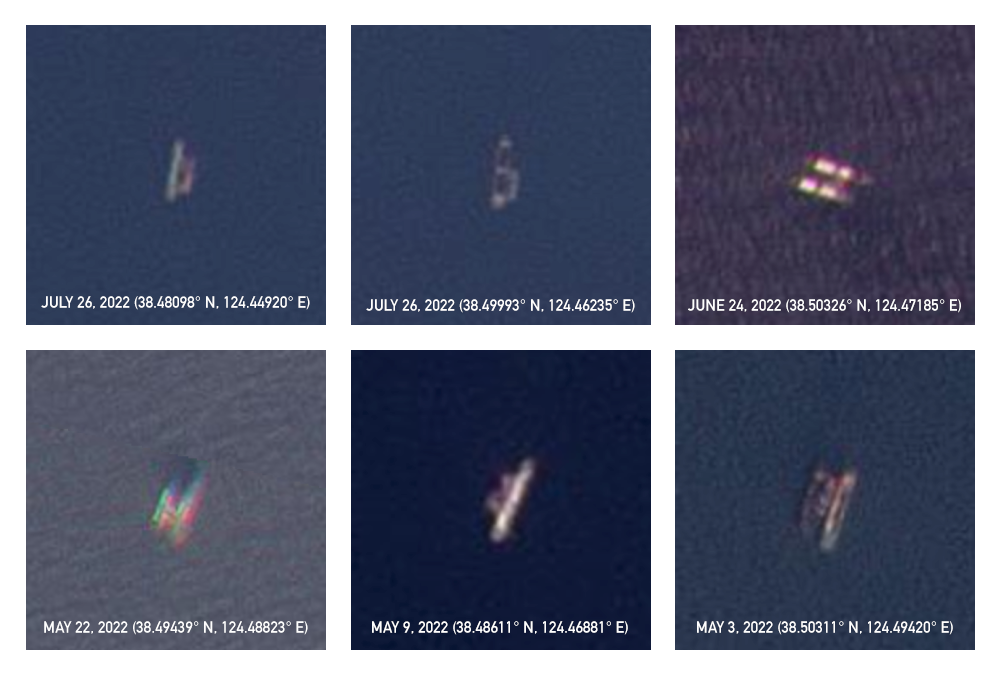 It’s difficult to discern what cargoes the vessels may have exchanged without high-resolution imagery. U.N. experts have routinely pointed to ship-to-ship transfers as North Korea’s main method for trading sanctioned commodities such as oil, iron and other goods. According to James Byrne, who directs open-source intelligence research at the Royal United Services Institute (RUSI) in London, more distant transfers serve two purposes. “Clearly, this makes the transfers more difficult to track and also moves the vessels away from ports where Pyongyang worries they may be a vector for COVID-19 transmission,” he told NK Pro earlier this year. Conducting transfers farther from the port means analysts need to sweep a much larger area for ships, assuming AIS location data is not available. MIXED SIGNALS AIS data shows that this is the first time that two of the three ships — the Jin Ye 18 and Ciyan 178 — are visiting Nampho in the last 12 months. The Shan He appears to have traveled to and from the area multiple times. However, anomalies in both the Ciyan 178 and Shan Hes’ AIS signals point to tampering. For the Ciyan 178, location data from China’s Maritime Safety Administration (MSA) shows a vessel with the same name and MMSI number (a unique radio identifier) docked near Chengyang, roughly 300 miles from its location in MarineTraffic. This suggests one of the two vessels is using the Ciyan 178’s MMSI number illegitimately, causing third-party services to show different locations. In the case of the Shan He, third-party location data and China’s MSA agree the vessel is 35 miles from Nampho’s lock gates. But satellite imagery reveals the vessel to be nearly 330 feet (100 meters) long, despite MarineTraffic and VesselTracker both listing its length as 262 feet (80 meters). 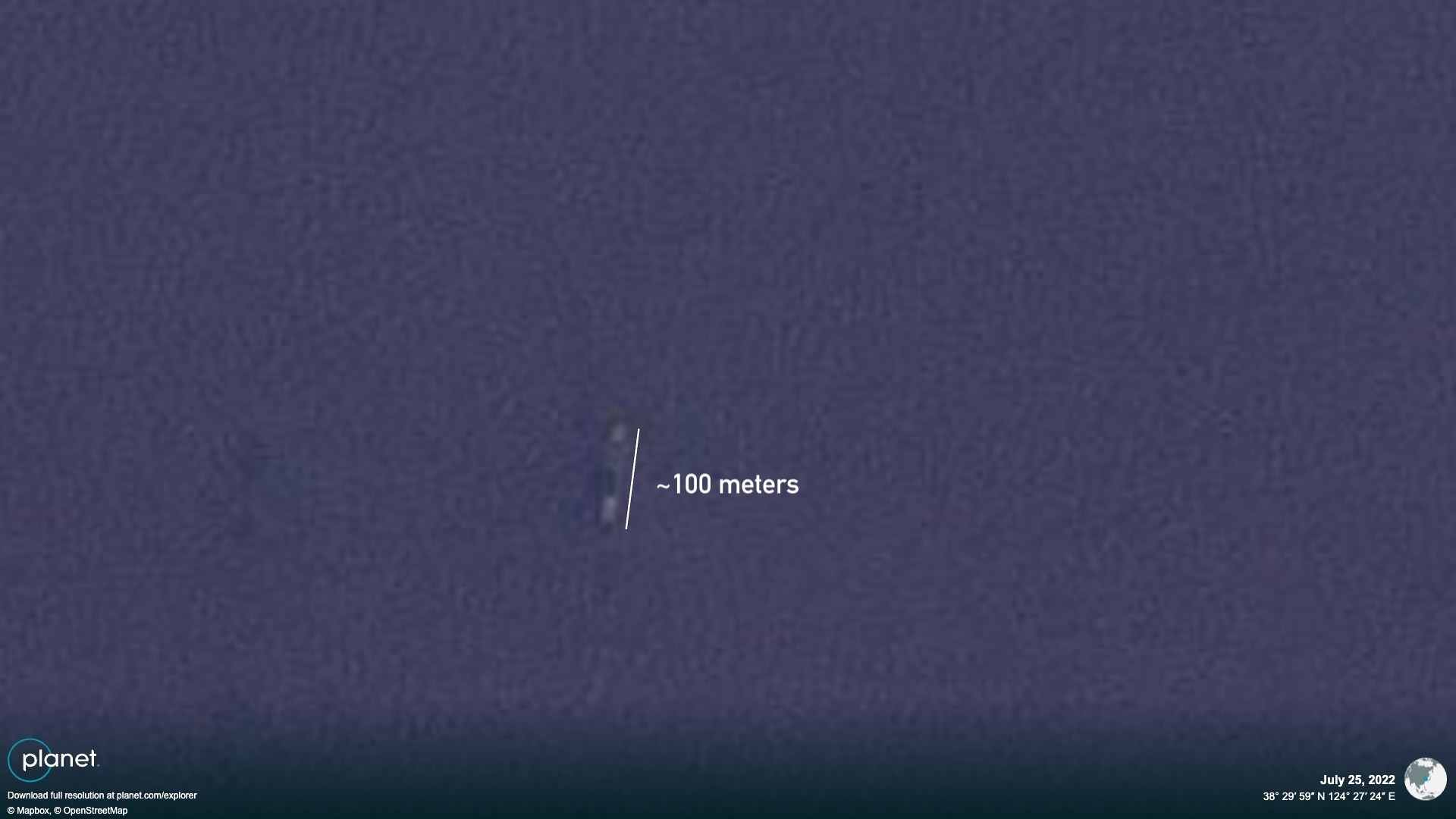 In addition, none of the three ships possess an International Maritime Organization (IMO) number, according to IMO and Chinese AIS records, possibly running afoul of regulations that require ships making international voyages to have IMO numbers. Edited by Bryan Betts © Korea Risk Group. All rights reserved. |

October 15, 2026Oct 15, 2026

The ultimate resources for professionals working on North Korea
 SHARE
SHARE COPY LINK
 X
X MASTODON