  News Ahead of Paektu trip, horse tracks replaced two of Kim Jong Un’s private runwaysNew infrastructure may have served as a riding practice ground before December's highly-publicized mountain trek 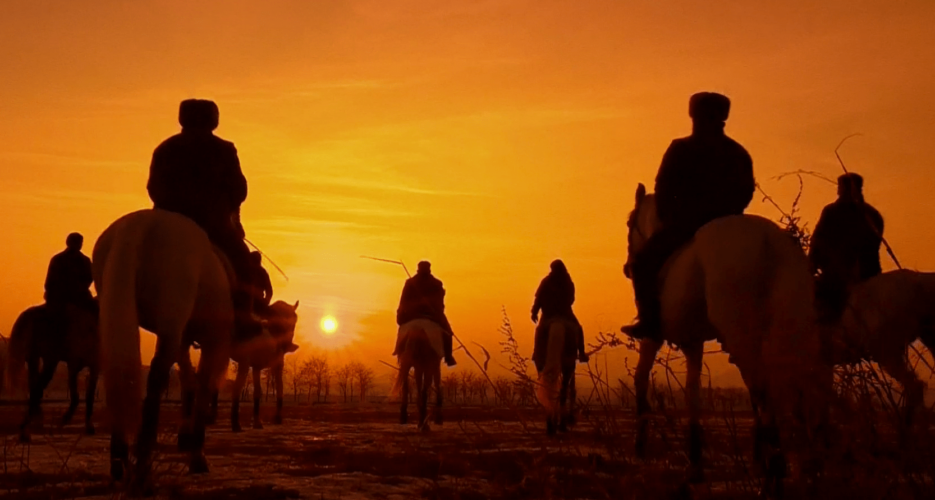 Once cited as indicative of the North Korean leader’s fondness for flight, recent satellite imagery reveals that two exclusive runways built near private mansions a few years into Kim Jong Un’s rule were suddenly torn down in late September last year and replaced with new horse-riding tracks, NK Pro has found. The timing of their rapid construction inside just over a month is notable, coming just before the year’s second high-profile visit by Kim and other top leadership figures to the “sacred” Mt. Paektu — visits which resulted in extensive state media reporting and a new hour-long propaganda film being aired daily since January 2. This, along with the fact that both new horse tracks are located within or next to known private Kim family compounds, suggests they may have been built with the purpose of providing practice grounds to top officials ahead of the lengthy ride around the Mt. Paektu area. From Rodman, to runway, to riding grounds Construction of both new elite horse tracks in Wonsan and Sinchon began in late September and appeared to have finished around mid-November, with the Wonsan track providing a particularly compelling look behind the scenes in the form of high-resolution Google Earth satellite imagery.  That location is also notable in that it is the site of an old helipad where American basketball star Dennis Rodman was greeted by Kim Jong Un in late 2013 before the two spent time at Kim’s luxurious mansion compound next door. A new private airstrip was then built on the site between March and July 2014, first reported by Curtis Melvin of North Korean Economy Watch. Melvin and others have reported on several of these new private runways built around the same time, with some suggesting they were part of Kim Jong Un’s affinity for flying — a departure from his father’s reported preference for train travel.   There is another private runway near Mt. Myohyang, though this one has not been replaced by a horse track or other facilities, according to the latest daily medium-resolution satellite imagery provided by Planet Labs. Back in Wonsan, though the runway is surrounded by swathes of empty land, its location directly next to an elite-use train station may have been reason enough for it to have been demolished to make way for the new horse track project. Demolition of the runway and work on the equestrian park began between September 18 and 23, Planet Labs imagery shows. While the runway was still standing by September 29, two circular and one square horse-riding practice areas had appeared directly adjacent, along with temporary structures nearby likely used for construction worker housing and storage.  By October 16, the runway was gone and the full oval track began to take shape, with three new support facilities and the track operational by the time actual horses and riders are seen in the November 14 high-resolution Google Earth image. A curious case in Sinchon Work on an identical horse track at a private mansion complex in the town of Sinchon (located south of Pyongyang) began in the same time-frame in late September as the Wonsan project, though the reason for destroying the airstrip is less clear in this case. The private runway here was first built between January and October 2015, according to Google Earth imagery and again reported first by the satellite imagery analyst Curtis Melvin. By October 11, 2019, the private runway had been removed, but the new horse track was not built in its place, instead being built in an empty patch of land within the compound a few hundred meters away.    But what appears to be an additional equestrian practice area not seen on the Wonsan track’s grounds was indeed built on the narrow, tree-lined strip of land where the runway stood just weeks earlier. Both this smaller area and the larger horse track appeared finished by November 9, high-resolution Google Earth imagery shows, complete with the same square and circular practice areas within the oval track, but with only a single attached building next to the track compared to three in Wonsan. The large track also appears identical to the Wonsan track, both in terms of the oval outer track, inner practice areas, and main adjacent building. Google Earth measuring tools show that both Wonsan and Sinchon tracks were built with nearly the same dimensions.  Practice for Paektu? Kim’s first Paektu visit of 2019, made public on October 16, served as propaganda further associating the North Korean leader with the politically and historically-significant mountain. State media reports of the visit also appeared to reference Kim’s self-declared year-end deadline to receive new concessions from the U.S. in their stalled negotiations, saying officials on hand were “convinced” through the trip that “a great operation to strike the world with wonder again” lay ahead.  But a second visit announced in state media on December 4 was even more elaborate, showing photographs of Kim and others riding horses around not only Mt. Paektu, but reportedly along a path including other “revolutionary” sites stretching dozens of kilometers. The new horse tracks that replaced the old private airstrips were not built in time for the first visit, where North Korea’s top officials were only seen in a single area near the mountain. But they were finished ahead of the longer journey which was likely filmed in late November or the first days of December — a visit which saw Kim’s horse adorned with new decorations and a saddle pad featuring his Chairman of the State Affairs Commission (SAC) emblem in gold, not seen in the October appearance. 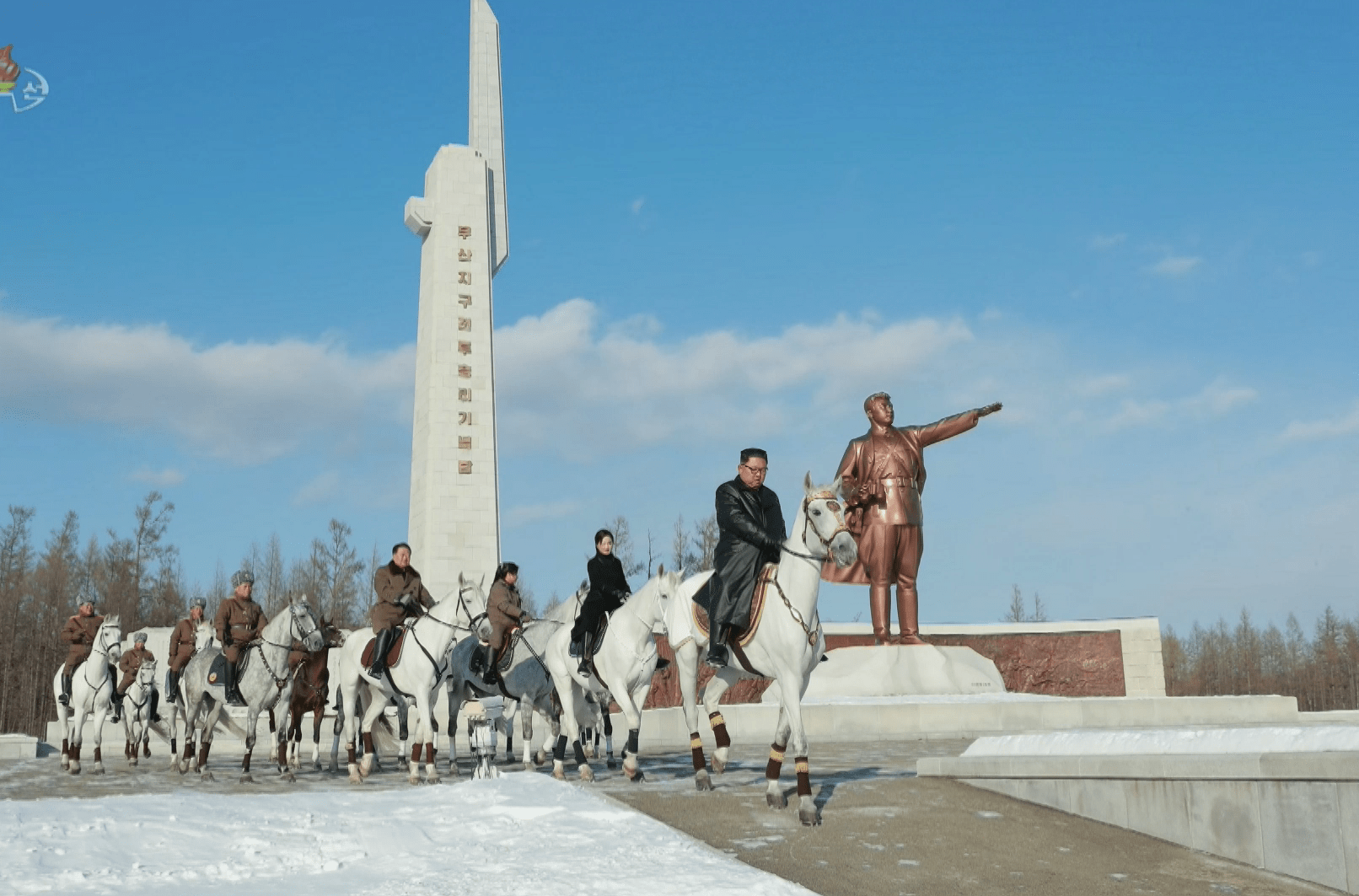 This material was turned into a new hour-long propaganda documentary being aired daily on North Korean television starting in the new year, featuring Kim and the others riding with apparently proper equestrian form, according to some commentators in South Korean media. While it is not possible to determine based on open-source satellite imagery and North Korean state media alone if the rapid construction of the horse-riding parks were in fact built for Kim Jong Un or the top officials who joined him in Paektu to practice for their propaganda trip, the timing and their locations make a strong case that the two are connected. Meanwhile, North Korean official media has continued to frequently promote the Mirim Riding Club in Pyongyang as a staple of the city’s newly-affluent classes. Equestrian activities also received another boost recently with Kim Jong Un’s announcement that a small horse-riding park was being added to the grounds of the nearly-complete Yangdok Hot Spring Resort in a November visit, ahead of its official opening a few weeks later.  Edited by Oliver Hotham © Korea Risk Group. All rights reserved. |

October 24, 2026Oct 24, 2026

The ultimate resources for professionals working on North Korea
 SHARE
SHARE COPY LINK
 X
X MASTODON