
|
Expert Surveys One year since the Hanoi summit, where next for North Korea-U.S. relations?Experts weigh in on why the second DPRK-U.S. summit failed, and where relations go from here
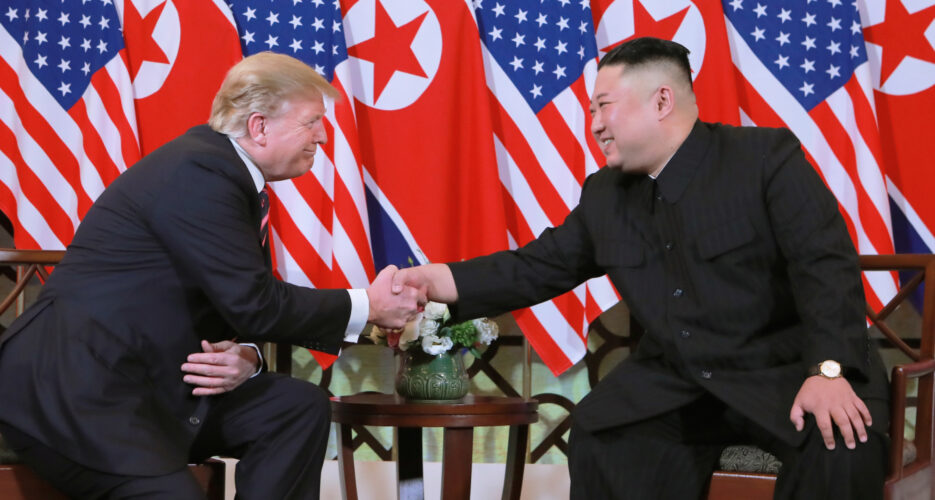 One year ago today, the DPRK-U.S. summit in Hanoi — the second such meeting between the leaders of the two countries — fell apart in acrimony. Following months of high hopes that Pyongyang and Washington would be able to build on the sparse agreement made the previous year in Singapore, President Donald Trump emerged after hours of talks with Kim Jong Un to announce that the U.S. had decided to walk away. The North Koreans, he said, had asked for “all the sanctions” to be lifted — a price the U.S. was simply not willing to pay. The North Koreans later contested that version of events, insisting that they had asked for some sectoral sanctions to be lifted in exchange for the dismantling of the Yongbyon nuclear facility. Regardless of who’s telling the truth about what happened, the failure of the Hanoi summit represented a major blow to prospects for DPRK-U.S. diplomacy from which the two countries have not recovered. North Korea conducted a total of 13 missile tests in 2019, and despite an impromptu third meeting between the two leaders in Panmunjom a few months later and a furtive attempt to hold talks in Stockholm that failed to produce results, little-to-no concrete progress has taken place since then. So, a year on, where does responsibility lie for the failure in Hanoi, and could the debacle have been avoided? What prospects are there now for a renewal of DPRK-U.S. diplomacy? And, should that process continue to ossify, what options does Washington have for a renewal of the “Maximum Pressure” policy? The following North Korea watchers responded in time for our deadline:
 With the benefit of hindsight, what was the biggest reason for the failure of the Hanoi summit to reach a deal?
In hindsight, strictly from the vantage point of the Hanoi summit, the personal rapport that Kim and Trump apparently felt they built during and after the Singapore summit may have done more harm than good. The failure of the Hanoi summit has had a lot of ramifications for Kim’s psyche and, in turn, for North Korea’s domestic and foreign policy, translating into North Korea tightening the noose domestically while resuming weapons testing.
In exchange for Yongbyon, Kim demanded the removal of the sectoral sanctions that constitute the core of the UN sanctions regime against North Korea. This offer was unacceptable to the U.S.
Summits between heads of state are often the byproduct of weeks or even months of intensive negotiations at the working level so that one could work out an agreement that the two heads of state could sign at a summit, if such an agreement is reached during these earlier negotiations. President Trump’s objection to North Korea’s demand for premature lifting of sanctions as well as Pyongyang and Washington’s diverging definitions of North Korea’s verifiable nuclear dismantlement were clear indicators that both the U.S. and North Korea needed more substantive dialogue at the working-level to iron out these differences before hosting such a high-level summit.
The U.S. side could not accept a freeze or dismantlement agreement that excluded such facilities because to do so would be to accept that North Korea would continue to produce fissile material for nuclear weapons, despite the existence of a “freeze” on the North’s production program at Yongbyon.
Instead, he barreled into Hanoi fully expecting that Kim Jong Un would immediately surrender his nuclear stockpile. That was never going to happen. U.S. Special Envoy to North Korea and Deputy Secretary of State, Stephen Biegun, is well qualified to lead these negotiations and he should have been given the authority to do so.  What do you think was the key lesson both sides took away from the summit?
Perhaps more importantly, the outcome of the Hanoi summit likely planted a seed of fundamental mistrust of the U.S. in Kim Jong Un’s mind, which we saw in his late December party plenum speech. For the U.S., the Hanoi summit likely proved once again that North Korea was not serious about completely giving up its nuclear programs, and that even if it could hammer out a nuclear deal with Pyongyang at some point in the future, it will fail during the implementation process, as did past agreements with North Korea.
Summits can fail spectacularly. And failed summits carry political risks, especially for the weaker and more vulnerable party, which is, in this case, Kim Jong Un.
Consequently, since Hanoi, Pyongyang’s increasingly hostile rhetoric, reluctance towards working-level dialogue, and the continuous short-range missile testing suggest the Kim regime will continue to rely on coercive bargaining tactics to force the U.S. to make one of these major concessions, namely premature sanctions relief, it the North will return to talks. On the U.S. side, similarly, it seems President Trump admitting the U.S. and North Korea’s contrasting definitions of denuclearization suggests that the two sides are far apart from achieving any sort of breakthrough for any sort of deal. Specifically, realizing this gap in perception should be the wake-up call for senior U.S. officials that the Kim Jong Un regime has not made the strategic decision to give up and dismantle its nuclear program, but rather continues to use summit diplomacy as a means to extort concessions from the U.S. and its allies.
They were wrong. The U.S. side learned how determined the DPRK is to preserve its ability to produce fissile material for nuclear weapons. Put another way, the Trump administration now understands how deeply wedded North Korea is to keeping its nuclear weapons.
Thus, Kim concluded that he needs to focus on direct engagement with Trump, and void the working-level negotiations from any substance and authority to negotiate. The President and his team believe that in Hanoi they “taught the North Koreans a lesson” by walking away, and that now they ‘know’ they should negotiate with the American working-level team. The fact that such negotiations have not yet materialized indicates that the Americans have misread what the North Koreans took from the Summit.  What hope does the U.S. have of rekindling the Maximum Pressure policy?
In fact, the U.S. may impose even more sanctions, such as putting restrictions on tourism, if Pyongyang resorts to such activities. High-level U.S. officials have always said they will be ready to deal with North Korea in whatever way it deems appropriate, and that insinuates imposing more sanctions if necessary.
However, if Pyongyang undertakes major escalatory moves, especially ICBM launches or nuclear tests, all bets are off. In this case, Washington is likely to drastically step up pressure on China, which is currently North Korea’s only significant lifeline. It is an open secret that since 2018 China has substantially relaxed enforcement of sanctions on the North and, moreover, has been providing considerable amounts of economic assistance to the DPRK, such as food and fertilizer aid. Washington has so far mostly turned a blind eye to China’s pro forma implementation of the sanctions. This, however, may all change if the U.S. administration decides to reinstate maximum pressure in response to North Korea’s provocative actions. Washington would demand China to seal the border with the North, threatening Beijing with secondary sanctions, new restrictions on American trade with China, etc. Attempts to establish a naval blockade of North Korea cannot be ruled out, too. My prediction for 2020 is that Pyongyang will refrain from moves that could antagonize Trump and bring back the maximum pressure campaign. The coronavirus is another reason for the DPRK to refrain from sharp and aggressive steps in foreign policy. In the next few months, the main priority for Pyongyang will be to deal with the COVID-19 threat as the country is extremely vulnerable to health risks.
However, several of these designations were essentially symbolic without significant substantive impact on enforcements effort. Additionally, while both U.S. Treasury sanctions and UN Security Council sanctions all remain in place, sanctions enforcement significantly weakened. The administration’s reluctance to pursue a Maximum Pressure policy could be in part due to the concern of re-stirring tensions and ending prospects for dialogue. This mindset, however, is problematic because since Hanoi the North Korean government has raised tensions with several ballistic missile tests as well as using more hostile rhetoric. Furthermore, to ensure that there are favorable circumstances for bilateral talks as Washington still prioritizes diplomacy to achieve North Korea’s verified nuclear dismantlement, it should consider employing a recalibrated pressure campaign. Such a shift in policy is required so that the U.S. and its allies can impose the necessary costs on Kim Jong Un and his regime to realize that their decision to withhold their nuclear and non-nuclear weapons of mass destruction significantly pose greater risk than benefit for his nation.
The international sanctions regime is fraying, and Pyongyang is showing itself to be increasingly adept at skirting UNSC-imposed sanctions. Meanwhile, the upcoming presidential election appears to have diverted the Trump administration’s attention from the North Korea issue. It remains to be seen whether Pyongyang will take steps to force Washington to pay attention.
When tensions are sky high and the leaders are engaging in public verbal attacks, the chances for some sort of accidental altercation are great and something like that could easily escalate into a larger conflict. Nobody wants that.  What prospects do you see for the restoration of DPRK-U.S. diplomacy in the coming year?
Plus, the speech reflected Kim’s fundamental skepticism of improving relations with the U.S. in the short or long term. In that vein, it is unlikely that Pyongyang will return to talks with the U.S. unless it is certain the U.S. will give sanctions relief and provide security guarantees. For the U.S. part, it seems that dialogue with North Korea is not a priority. All the point persons for talks with North Korea have moved on to other positions, for one. Furthermore, President Trump will probably not want to spend too much energy on North Korea in the run-up to the presidential election unless he can be sure it will lead to a tangible outcome.
There is little chance for serious negotiations between the U.S. and North Korea in 2020. However, if re-elected, Trump could quickly reopen active diplomacy with Kim Jong Un. This may be another reason for Kim not to make aggressive moves until the U.S. presidential election is over. You don’t want to destroy the relationship with a man who could be the U.S. president for another four years. If there is a new president, such as Sanders, who has already expressed willingness for dialogue with Kim, talks could also resume, although definitely not in 2020.
However, even if Washington pursued such an option, it would take time for the imposed costs, whether its stronger sanctions enforcement, enhanced extended deterrence, diplomatic isolation, etc, to have a significant impact in altering Kim Jong Un’s strategic calculus. Finally, the more immediate factor negatively impacting the likelihood of diplomacy is the coronavirus outbreak. The North Korean regime’s attention seems to be focused on preventing an outbreak of this new threat, which in turn may put the issue of negotiations even further on the backburner in Pyongyang.
And with the Trump administration focused largely on political survival, there seems little incentive to resume diplomacy with North Korea, especially since Washington knows well that denuclearization is not in the cards.
American families get their relatives’ remains repatriated and North Korea could get desperately needed funds or even medical supplies. With the coronavirus outbreak in the region, there is a very good chance that North Korea will be in even more need of basic medical supplies.  How highly do you rate prospects of the U.S. getting a better deal with North Korea in the next five years?
For example, if the U.S. provides full or substantial sanctions relief, pledges huge amounts of economic aid, and provides sustainable security guarantees, such as normalizing U.S.-DPRK diplomatic relations, I think North Korea could agree to give up more than just Yongbyon.
However, the U.S. might take a compromise deal that significantly reduces North Korea’s nuclear and missile capabilities while leaving it with some minimal deterrence force. In effect, that would be a return to the Kim Jong Il era. Kim Jong Un’s father maintained a limited nuclear capability that kept Japan and South Korea within range and was just enough for deterrence purposes.
While several aspects of the first Maximum Pressure policy between 2017 and 2018 were effective in targeting critical sources of revenue for the regime, it did not have enough time to have the full impact it should have to induce significant change in Pyongyang’s strategic calculus. A renewed pressure campaign should be given more time to have such an impact in which it forces the Kim regime to realize that there are more problems than benefits to retaining and building up its nuclear and non-nuclear weapons of mass destruction.
Rather, we’ve had a few substance-lacking photo ops while U.S. intelligence satellite imagery shows that North Korean missile bases remain active. Edited by James Fretwell © Korea Risk Group. All rights reserved. |


 SHARE
SHARE COPY LINK
 X
X MASTODON




Recent Stories