
|
COVID-19 Coronavirus may affect upcoming U.S.-ROK military exercises, defense chiefs say"The situation is quite serious," South Korean defense minister Jeong Kyeong-doo tells press at the Pentagon
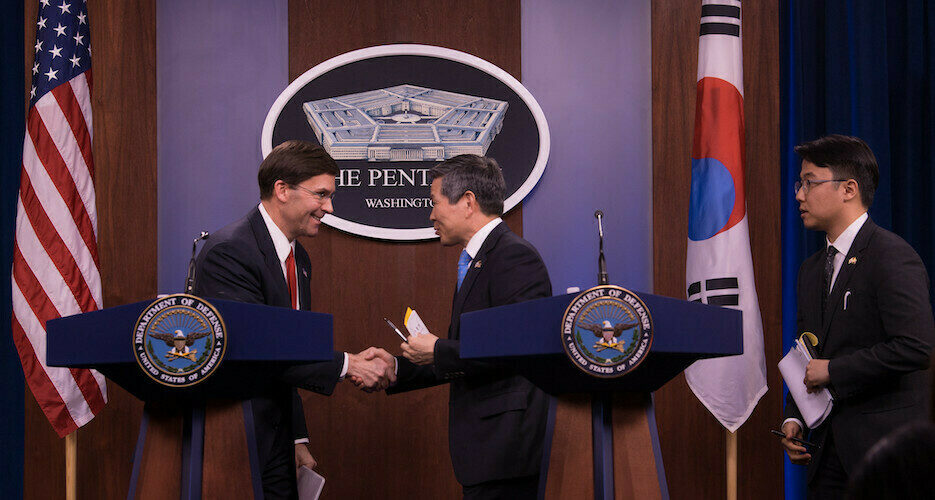 The U.S. and South Korea may scale back upcoming military exercises because of the fast-spreading coronavirus, the two countries’ defense chiefs said following talks at the Pentagon on Monday. The revelation comes amid growing concerns over the damage that the virus, known as COVID-19, has begun to cause in East Asia as cases continue to rise throughout South Korea with still no cure in sight. Speaking to reporters at a joint press briefing, U.S. Secretary of Defense Mark Esper and South Korean Minister of National Defense Jeong Kyeong-doo made clear that the epidemic has now grown to a point that it is affecting their military planning. “General Abrams and General Park are looking at scaling back the command post trainings due to concerns of the coronavirus,” said Esper, referring to Gen. Robert Abrams, Commander of U.S. Forces Korea, and Gen. Park Han-ki, South Korea’s Joint Chiefs of Staff Chairman. “As those two officers address any concerns, I’m sure we will remain totally ready to deal with any threats that we might face,” he said. “The situation is quite serious,” South Korea’s Jeong stressed. South Korea has hundreds of reported cases of COVID-19 in recent days. At least one of them was the wife of a retired U.S. Forces Korea soldier, according to a tweet by General Abrams. “We were saddened to hear of her of contracting the virus,” Abrams said. “We pray for her recovery.” A reporter at the Pentagon on Monday also asked about the coronavirus in North Korea, known to have one of the worst public health systems in the world and to be uniquely vulnerable to an outbreak. The DPRK has reportedly implemented numerous measures to try to prevent an outbreak from erupting inside the country, including lengthy quarantines, a locked-down border, and the cancellation of some public events like the upcoming Pyongyang marathon. Esper provided no information on the situation in the North. “I don’t have anything to offer,” he said. Defense Minister Jeong was welcomed to the Pentagon on Tuesday with all the pomp and ceremony of an important guest. After arriving in his motorcade, he and Esper stood outside the building as cannons burst and a military band dressed in bright red performed the two countries’ national anthems.  Speaking to reporters afterward, Esper called the U.S.-South Korean alliance “ironclad,” and both men were quick to note that this year marks the 70th anniversary of the start of the Korean War. But their meeting also took place at a tense moment in the relationship between Washington and Seoul — namely over the contentious issue known as “burden sharing,” or how much Seoul should have to pay to maintain the U.S. military presence in South Korea. President Trump has reportedly demanded a fivefold increase in those payments, though it is unclear how his administration calculated that number. The two countries have been unable to reach a compromise, and some South Korean employees on U.S. bases in Korea are expected to lose their paychecks in the coming weeks if Washington and Seoul don’t reach a deal. The defense chiefs’ remarks on Tuesday did not yield any hints that those negotiations were ready to end soon. Amid the various challenges on the Korean peninsula and within the U.S.-South Korean alliance, one former U.S. government official told NK News that the move to scale back the military exercises was a rational one, given the risks that the coronavirus can pose to even the strongest soldier. “It makes sense that the allies are taking coronavirus into account as they look at future exercises,” said Mintaro Oba, a former State Department official working on North Korea. “The point of these exercises is to demonstrate unity and strength while reinforcing our forces’ readiness and ability to coordinate, and it’s always worth considering scaling back if there are factors that limit our ability to do that effectively and safely,” he continued. “Of course, there’s a broader lesson to consider from the coronavirus crisis, too: potentially destabilizing threats on the Korean Peninsula can arise in many forms, at any time,” he added. “The United States and South Korea will have to look to the future and work to ensure they can be closely coordinated and effective together however difficult the circumstances.” Edited by Oliver Hotham © Korea Risk Group. All rights reserved. |


 SHARE
SHARE COPY LINK
 X
X MASTODON


Recent Stories