
|
Evergreen A North Korean school of rock: teaching heavy metal to Pyongyang school girlsFunky Sueyoshi reflects on his time at the June 9th school — and whether music could ever inspire change in the DPRK
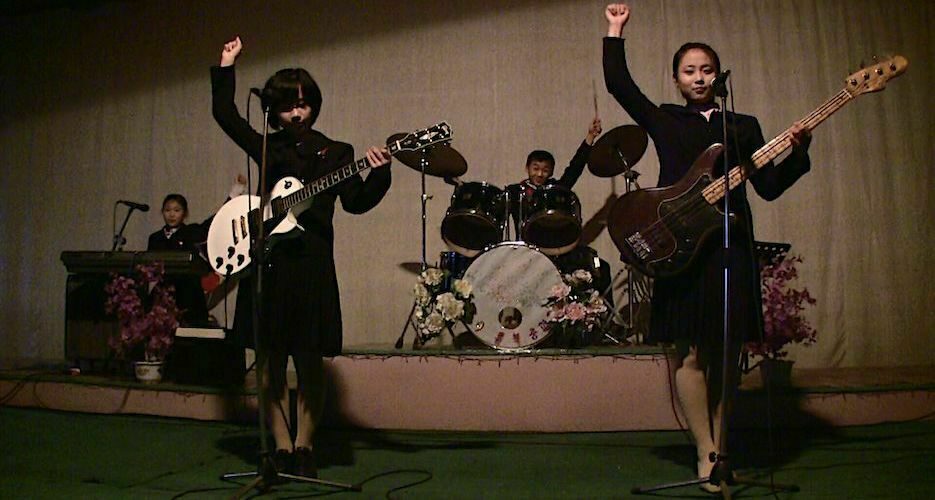 I’m waiting in the basement of the Umeda Zeela concert hall in Osaka, Japan. In just a few hours, drummer Funky Sueyoshi will be performing a 20th-anniversary concert with members of his band, X.Y.Z.→A (pronounced X, Y, Z to A). Wearing a simple T-shirt and his long white hair not quite stage-ready, Sueyoshi greets me cheerfully. His exterior is certainly that of a rockstar, but the man I’m talking to is far from your typical Japanese musician. In 2006, his friend, a researcher and photojournalist named Masayuki Aramaki, asked him if he would be interested in visiting North Korea. After enthusiastically agreeing, the course of his musical career changed forever. His goal? Facilitate cultural exchange by introducing rock music to local students. So began what Aramaki and Sueyoshi dubbed “The North Korea Rock Project,” which resulted in the drummer visiting the DPRK five times between 2006 and 2012 and later became the subject of a memoir of the same name.  ROCK AND ROLL DIPLOMACY Bringing rock to a place where foreign media is typically seen as anti-revolutionary is prohibited — especially as a citizen of a nation long seen as one of the country’s worst enemies — would have proven to be a daunting task for most. But Sueyoshi viewed it as a challenge he was more than happy to undertake in his role as a musical ambassador, and in many respects, he was already an ideal candidate for going to the DPRK.
Along with establishing a successful music career with the bands Bakufu Slump and X.Y.Z.→A, the 60-year-old Kagawa Prefecture native maintained long-term residence in China, and still regularly travels back and forth. His acquired fluency in Mandarin even once earned him a recurring spot on NHK’s foreign language education programs. In the 1990s, Sueyoshi took an active role in promoting the underground Chinese rock scene, at a time when the Communist Party still frowned upon public performances of the genre. His time in that country allowed him to have an open mind in making his first voyage to Pyongyang on July 5, 2006, he now says.  “It’s because I know China that I was able to go to North Korea,” he tells NK News. Having made his mark in one country that was both hostile to rock music and tense with its relations towards Japan, he adds, he was able to learn from those previous experiences. “I was able to look at North Korea more easily,” he considers. “But even still, I was surprised by many things.” Relations between Japan and the DPRK have been tense for decades, with the abduction of over a dozen Japanese nationals by North Korean agents during the 1970s and 1980s remaining the biggest barrier towards a normalization of ties. On the other side, memories of Japan’s exploitation of Korea during the colonial period remain strong, with the country’s education system instilling in the people a hatred of the peninsula’s former occupiers. Sueyoshi, however, does not see himself as a political person, and says he actively avoided tackling contentious subjects upon being invited to Pyongyang.  “It was the same for me in China as well,” he explains. “If I discussed the relationship between Japan and China with other Chinese, I thought that things would quickly worsen so I was reluctant to do so.” It was thanks to Masayuki Aramaki that he was able to have access greater than the typical foreign visitor to the DPRK. The photojournalist had visited the country dozens of times and his extensive connections to various North Korean guides allowed him to personally vouch for Sueyoshi, as long as the purpose of his time in the country was explicitly defined as cultural exchange beneficial to Kim Jong Il’s regime.
JUNE 9TH MIDDLE SCHOOL Located in Pyongyang’s Taesong District, June 9th Middle School’s construction was ordered built by Kim Il Sung himself, and its name was derived from the building’s date of commission. Sueyoshi viewed it as a good omen: 6/9 chords are commonly found in jazz and rock. “My heart beat: for some reason I felt that this was a pre-destined sign,” he recalls in his memoir. Led to the second floor of the campus’ innermost building by his guides, Sueyoshi was given a show by the school’s music club. While interested in hearing the music traditions of the DPRK, he remembers that the music was “about the furthest thing from rock one could get.”  NK News asks him what separates North Korea’s music from neighboring Asian countries. Noting that while those in political positions are tasked with creating explicitly propagandistic songs, Sueyoshi considers that distinct from the traditional “ethnic music” of the Korean people as a whole. “Both China and Japan play their music in quadruple time,” he explains. “Only North Korea and Indonesia have rhythm that’s divided in triple time.” Citing an example, he mentions “Arirang,” a staple folk song in both Koreas. “Arirang is a very famous Korean song and it’s in triple time,” he mentions as he quickly taps an illustrative rhythm. “It’s all tied together in this emotional bond. That kind of ethnic music is very rare, so I have an interest in North Korea’s.” BARRIERS TO ENTRY The first challenge the project had overcome was not from the North Korean side, but from the Japanese. Bringing musical instruments and equipment to a heavily-sanctioned country entered a sensitive legal area that Sueyoshi took great pains to avoid, so he decided early on to move everything from China. “All the stuff was Chinese-made,” he says. “Japan had placed economic sanctions then, and even now they’re still there, so I figured that as a Japanese person, taking Japanese products in wouldn’t be a good idea.” “Question mark,” one of the songs recorded by Funky Sueyoshi and his North Korean students Beyond legal issues, there was also the potential negative effect it could have on Sueyoshi’s career. “If Japanese people just hear the word ‘North Korea,’ it’s unpleasant for them,” he remarks. “If you go to North Korea, there are people who respond negatively.” Luckily, it was rock’s status as a counter-cultural symbol that decidedly changed the minds of most people and allowed him to receive more public support than he initially expected. “Some thought that I was bringing anti-establishment material to North Korea, even if that wasn’t my intention,” he adds with a laugh. “My intention was to foster positive cultural exchange, but optics-wise, rock helped my case. It was like a sort of magic.” When he arrived at Pyongyang International Airport, however, he ran into another problem. With the luggage of all foreigners entering the DPRK meticulously inspected, Sueyoshi had to provide an explanation for his unconventional cargo.
“The airport staff had no idea what recording equipment was,” he chuckles. “So I simply explained and decided to tell them that it was a donation to the school.” Having gotten past these initial obstacles and successfully arrived at the school ready to teach, it was time to begin the rock music education of young teenage North Korean students who had not even heard a note of the genre.  MUSIC FOR THE MASSES From the outset, Sueyoshi was under strict observation and was prohibited from actually using the word “rock” to describe the work he was doing. “The military institution was next door. When those soldiers heard what we were playing, obviously it wasn’t their country’s music,” he remembers. “They heard foreign music and were like ‘What the hell are you guys doing?’” Furthermore, he was prevented from introducing his students to foreign music, in accordance with the DPRK’s tight hold on information control. “The guides said that it could end up getting somebody in trouble,” he says. “That’s why, with the exception of me performing for them or giving instruction, they didn’t listen to anything. We created original stuff instead.” Despite having no prior exposure to rock, Sueyoshi recalls that his students worked very hard to follow his instructions and that they strove for perfection. “They would practice with utmost effort even after going home. When they came back the next day, they would have mastered the material,” he says. “North Korea is a society where if you fall behind, you can’t live, so I really felt that they diligently gave their best effort.”
The results of Sueyoshi’s direction and the efforts of the students can be heard in their debut recording, an original song titled “Question Mark”. In addition to their musical collaboration, a form of rare cultural exchange had also taken place.  Despite the obvious language barrier, Sueyoshi’s memoir describes numerous positive interactions with the students, as well as the humorous nicknames he gave them. Frequent power outages interrupted many of their recording sessions, but it was during those moments of downtime that they were able to bond. “I was probably the first Japanese person they had ever met,” he explains. “More than me telling them ‘This is what a Japanese person is,’ though, I wanted them to view me positively as an individual, and I think we were able to build a good relationship.” Throughout his multiple visits to the DPRK, students graduated and the music club went through several membership changes. Eventually, having to repeatedly say goodbye to pupils who he would likely never see again ultimately proved too painful. He also began to believe that he had achieved the most he ever would under the heavy restrictions. The North Korea rock project wrapped up in 2012, shortly after Kim Jong Un’s ascension to power.  COUNTRY BLUES Despite his apolitical nature, Sueyoshi is hopeful that relations between Japan and North Korea can one day be normalized after decades of hostility. At the same time, he understands that the road to this reform is a very distant one. “With the summits between North and South Korea and summits between North Korea and America, I can’t avert my eyes from it,” he says. “I really thought that North Korea and America would establish something, but it hasn’t really progressed.”
He also remains critical of his own government’s handling of the abduction issue and its reluctance to properly engage with the DPRK. “There are aspects of the abduction issue that are complicated, but there are parts of me that think that Japanese politicians are intentionally making it more difficult on purpose,” he considers. “We have to solve this issue, but because they have such a stubborn way of thinking, that’s still challenging.” Beyond policy, however, Sueyoshi believes that the Japanese mass media has a major effect on influencing public perception of North Korea and that there are “big problems” with their relentlessly negative coverage. “I think that the Japanese mass media is biased towards one side, so without always believing what they say I’d like for Japanese people to think more for themselves,” he says. “I’d also like for members of the media to really do research because I think what they report has a huge impact.” And what about rock music serving as a vessel for change in North Korea? Despite its historical association with anti-regime protests in East Germany before the fall of the Berlin Wall, Sueyoshi remains skeptical that the same thing could happen in the DPRK. “They’ve created a militaristic system where protests can’t happen, so any places rock got into would be labeled as anti-revolutionary,” he says. “I think it would be quite difficult.”  Sueyoshi acknowledges the strides Pyongyang has made in improving the lives of its citizens since he first visited, but he believes that full economic liberalization is the only way forward. This, however, is also a very difficult prospect. “It’s impossible to import only foreign goods and not the information that comes with them,” he explains. “Their citizens’ education, brainwashing, or whatever you want to call it would collapse from that.” “It would be a big problem for North Korea. But if they don’t liberalize, their economy isn’t going to turn around.” More positively, he considers groups like the Moranbang Band — believed to be personally organized by leader Kim Jong Un — to be a forward-thinking development for the DPRK culturally. “They’re attractive and have a true performance quality to them,” he praises. “They perform music from foreign movies and other stuff, so I think that for the average North Korean who can’t experience that kind of media, they can at least listen to them.” Before wrapping up the interview, NK News asks Sueyoshi what he wants Japanese people and others in the outside world to understand the most about North Korea. “I don’t think it’s good to portray all North Koreans as bad,” he says. “I’d like for there to be a better relationship between peoples, and for governments and people to be viewed separately.” Naomi Kawanishi provided translation assistance Edited by James Fretwell and Oliver Hotham © Korea Risk Group. All rights reserved. |


 SHARE
SHARE COPY LINK
 X
X MASTODON


Recent Stories