
|
News Overarching goal of sanctions is dialogue, but key hurdles remainEven if conditions emerge for dialogue, hurdles and historic record give little cause for hope
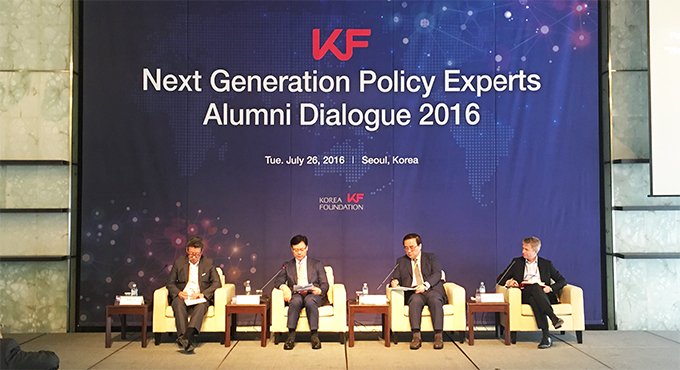 The recent ratcheting of international and bilateral sanctions against North Korea is ultimately geared towards resuming credible negotiations with Pyongyang, international experts said at a Seoul forum on Tuesday. That’s despite there being a variety of motivations driving sanctions at the United Nations Security Council and bilaterally, from countries like the United States and South Korea. “The real purpose (of sanctions) is to try to persuade North Korea to come back to the negotiating table, to let them know that the pain they suffer from sanctions can not work in the long-term,” said Dr. Victor Cha, senior advisor and Korea Chair at the CSIS think tank in Washington, D.C. And while some have suggested D.C. might be tightening the noose in order to bring about a collapse of the North Korean government, Cha said that was not the case: “That’s not just a talking point, I think they really mean that.” Local expert Professor Park Ihn-hwi said the current sanctions policy, supported by the U.S. and Japan, should be maintained to send a “clear message to North Korea regarding the importance of denuclearization.” “At the same time, once we see any kind of positive outcomes…we have to think about a talk and dialogue and diplomatic negotiation, additionally, to apply to North Korea.” The third panelist at the South Korea-linked Korea Foundation event agreed. “Fundamentally, a primary focus (of sanctions) is to get North Korea back to the table and engage in discussion,” said Dr. John Nilsson-Wright, of Chatham House in London. And a minimum – somewhat possible – goal of those discussions, Nilsson-Wright explained, would be a freeze of North Korea’s nuclear capabilities and prevention of further nuclear and ballistic missile tests. “A second more ambitious agenda of course, which is far less likely to be successful, is some mechanism to ensure a rollback of North Korean capabilities.” And a “third …is to talk more broadly about normalization with North Korea, to open the door to possibly more extended discussions to bring North Korea back into the international community.” Regime change as fourth rationale for sanctions, Nilsson-Wright added, was an “ambitious idea” that is “extremely unlikely”. HURDLES TO NEGOTIATION Despite agreement that sanctions could ultimately lead to dialogue, the experts agreed that several major hurdles remained to be overcome, some of which could prove extremely difficult in the short-term. One of the issues, Washington’s decision to formally sanction Kim Jong Un over human rights violations, could make it extremely difficult for the U.S. to resume negotiations, even if Pyongyang wanted them, said Dr. Cha. “Because you know, the first things the North Koreans will ask for as a condition of getting back on the negotiating table, is taking their leaders name off that list. And that will be difficult to swallow for “any new administration, whether President Clinton or President Trump,” he said. “All of a sudden the President of the United States takes Kim Jong Un off the human rights abuser list, just for the sake of talks.” And in the short-term, the U.S. election itself gave little reason for Pyongyang to consider talks, even if sanctions might be putting the regime there under pressure, said Nilsson-Wright. As such, it makes more sense for Pyongyang to “play the waiting game…to see Trump’s possibility of winning the contest as an opportunity to do what North Korea has historically always done: dividing the U.S. from regional partners.” Looking back from a South Korean perspective, Professor Park said the historical record gave little reason for optimism. “We realized that after almost two decades of engagement discussion and negotiation, (that) diplomatic tools did not manage to change North Korean behavior or lead to denuclearization,” Park said. Main picture: NK News © Korea Risk Group. All rights reserved. |

October 20, 2026Oct 20, 2026


 SHARE
SHARE COPY LINK
 X
X MASTODON